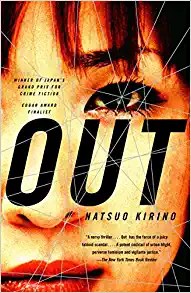
Out, By Kirino Natsuo
Translated by Stephen Snyder
(1998, translated 2003)
(Novel)
This thriller is a brilliantly structured character study of four women who work a night shift at a factory that produces ready-to-eat meals to be sold in convenience stores and mini-markets. Three are the primary caregivers in their family and live from paycheck to paycheck. “The Skipper” is an older widow trapped caring for her dead husband’s mother and a grandson her heartless daughter abandoned on her doorstep. Yoshie is an attractive mother of two whose husband has lost all their savings in gambling. Masako is in a moribund marriage with a teenage son who resents her so much that she can no longer recall when he stopped talking to her. The one singleton is Kikun, a self-involved, compulsive shopper who fantasizes that the right outfit will help her catch a man who can help her manage her burgeoning debt. The inciting incident occurs when Yoshie kills her husband in self-defense. She begs her friends to help, and surprisingly, they do, agreeing to dismember the body and scatter the pieces throughout Tokyo. Kirino’s heroines, particularly the Skipper and Masako, stand out for their pragmatism, loyalty, and their commitment to helping one another out. They all can sympathize with Yoshie, whose drunken, physically abusive husband had beat her and bankrupted the family. The novel is decidedly feminist. Kirino relates the backstory of each woman, as well as the story of Anna, a Chinese student who came to Japan to make quick cash in the entertainment industry and wound up working in prostitution, revealing how they are limited by and ultimately consumed by society and the failing economy of the 1990s. Kirino takes us into the world of other marginalized people, like the Japanese-Brazilian laborers who came to Japan to see the land of their fathers and find they are outcasts in Japan. She also brings to life menacing loan sharks and low-level yakuza, in the process explaining how they ply their trade. Finally, she introduces a maniac into the mix. The demonic activity of a murderer and rapist is appalling. It may completely distract from the otherwise consistently feminist theme of the novel, but it is also true that Kirino’s characters know that they must pay a price for their crime. On the night of the dismemberment, one of them even states that she knows that she will go to hell for what she is about to do; the tragedy for these women is that hell is full of men. A movie version of Out was released in 2002; it was directed by Hideyuki Hirayama.
“They waited while Yoshie went to park her bike in the racks next to the factory, and then climbed the green, Astroturf-covered stairs that led up the side of the building. The entrance was on the second floor. To the right was the office, and down the corridor was the workers’ rest area and the locker rooms. The factory itself was on the ground floor, so once they’d changed, they would make their way downstairs. Shoes had to be removed on the red synthetic carpet at the factory entrance. The fluorescent light washed out the color of the carpet, so that the hallway looked rather gloomy. The complexions of the women around her also seemed darkened, and as she looked at her weary companions, Masako wondered if she looked as bad herself.”
 East Asian Literature in Translation