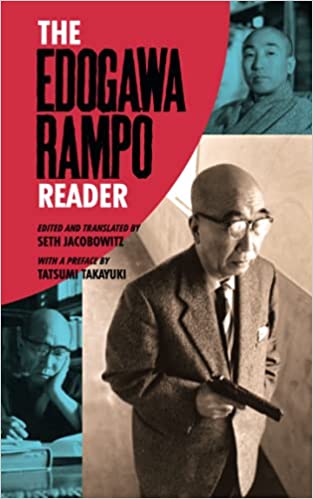
The Edogawa Rampo Reader, by Edogawa Rampo
Translated by Seth Jacobowitz
(2008)
Collection of Essays and Short Stories
If you tell a Japanese student you love mysteries or Edgar Allen Poe, they will ask if you have read Edogawa Rampo, Japan’s mid-century master of the eerie and the mysterious. The author’s name is his own creation, rich in double meanings, and a homophone for his role model, Edgar Allen Poe. The works in this collection are never-before-translated versions of Rampo’s short stories and essays, most composed between 1923 and 1955. He created his own genre, something he called “ero guro nansensu” from the three words “eroticism, grotesquerie, and the nonsensical.”
Though Rampo often focuses on crime, criminals, and detection, he is not so much concerned with traditional literary detection as with delusional narrators or characters who are in the midst of some crisis involving a rift in their perception of reality. Rampo also wrote about his contemporary detective novelists, as well as important essays on the history of the uses of fingerprinting in the Meiji Period. His autobiographical “A Passion for Lenses” reveals Rampo’s fascination and anxiety about the exploding technology around vision and how the new media of photography and cinematography are changing our experiences of reality. Interestingly, late in his career he worked with the anthropologist Jun’ichi Iwata on a project to compile a historiography of literature featuring male homosexual desire.
“They were projected all too clearly like a terrible nightmare or the drug-induced visions of an opium fiend. Even though I knew it was a play of the lens, I felt peculiarly upset. I suppose most people would think it odd to feel frightened. But I was overwhelmed by its reality. It was so shocking that from that day onward, my view of things changed completely. It was a turning point in my life. I am not exaggerating in the least. I lack the courage to stand in front of a concave mirror and see it reflect things back a dozen or more times larger. Whenever I come across a concave mirror, I run in the opposite direction. In the same way, I have to gradually steel my courage to peer into a microscope. The magic of lenses is more terrifying to me than most people could possibly imagine.” (“A Passion for Lenses”)
 East Asian Literature in Translation