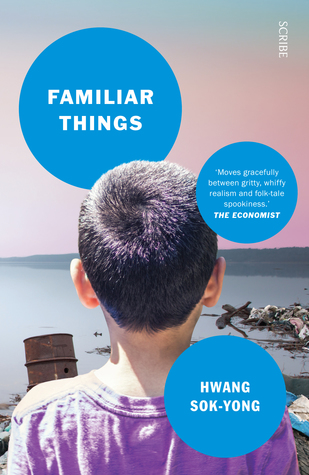
Familiar Things, by Hwang Sok-yong
Translated by Sora Kim-Russell
(2011, translated 2017)
Scribe US
(Dystopian Coming-of-Age Novel)
The first fifty pages of Familiar Things read as if we are in a future dystopian hellscape. Children and adult “astronauts” clamber over mountains of refuse that dominate “Flower Island” on the Han River, eking out a living by recycling industrial refuse and eating discarded food. The thousands who live there rarely leave the island, but when they do, even after bathing for two days and buying new clothes, they are ostracized by the citizens of Seoul who recognize them by their smell. Like any world-building fantasist, Hwang details the different clans, alliances, and rivalries, as well as explaining the economy of the island. The two heroes of the story, twelve-year-old Baldspot and his friend, Bugeye, find refuge from the toxic atmosphere at one end of the island where they find a grandfather figure and shaman-like woman who feeds the dogs of the island and communicates with the “Kims,” a family of dokkaebi or goblin spirits that have been living and farming on Flower Island since time began. As the children become closer to the glowing blue dokkaebi, they also get a chance to get off the island, where they watch Star Wars and buy a Mario Brothers game. Here Hwong proves himself a magician. The movie and the game are not artifacts from the past: Star Wars and Mario Brothers are premiering. Hwong is not writing science-fiction about Seoul’s far distant dystopian future, but about a crisis that occurred in the 1980s. Hwang’s “Flower Island” is actually Nanjido, which was famous for its production of flowers and peanuts until Seoul committed to using it as a landfill from the 1970s to the 1990s, creating an environmental nightmare as well as a human catastrophe. Hwang’s ecological message will appeal to students and adults, and the relatable, infectious relationship between Bald-Spot and Bugeye is genuinely delightful.
“People threw away so many things that by the time the objects lost their shape and decomposed into smaller and smaller and more complex parts, they became strange and curious objects that bore no resemblance whatsoever to whatever the machines in the factories had originally spat out. Bugeye gazed down at the moonlit grass and nearly murmured, I want to fly away.”
 East Asian Literature in Translation