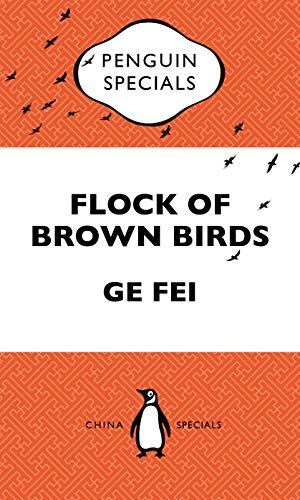
Flock of Brown Birds, by Ge Fei
Translated by Poppy Toland
(1989, translated 2016)
(Avant Garde Novella)
This work is famously representative of the avant-garde literature movement of the late 1980s. In his introduction to the Penguin publication, Ge remarks that reading it again after twenty years he hardly recognizes the work and confesses–perhaps with a wink–that the reader should not feel bad if she does not comprehend the work as he does not understand it himself. The narrative evolves in a loop-like form. Situations and conversations repeat themselves, and although the narrator discourses extensively on the nature of time, all action takes place in a world outside of history and current events. There is no calendar and no clock, only a flock of brown birds the narrator uses as a keeper of time. The narrator styles himself as a type of St. John working in a sandy, riverine environment on his own Book of Revelations. The most linear elements of the narrative involve women. The core story is of the entry of a woman into the man’s life, their blossoming relationship, and her death on their wedding day. One day a new woman enters the narrator’s world. Her name is Qi, and although she claims to know the narrator, the narrator has no recollection of her. Perhaps as proof of her existence, she carries with her a portfolio of drawings of her; these, however, fail to remind him of their connection. That evening, the narrator holds Qi in his arms while he relates the story of his tragic love. They part, and a year later she returns. The narrator attempts to reconnect with Qi, yet this time she refuses his overtures and insists that he is a stranger to her. Readers familiar with Kafka and Borges will find themselves in familiar territory as Ge explores the nature of narrative and its relation to the truth as well as to the relationship between the narrator and his subject.
“Like a great ship, this season has run aground. Dawn and dusk alternate at an old man’s pace. I live alone in an area known as the ‘Waterside’, writing a book akin to the Revelations of St. John. I wish to dedicate it to my former lover. She became over-excited at the candle-lit dinner held for her thirtieth birthday, suffered cerebral thrombosis, and died. After that I never saw her again.” (1)
 East Asian Literature in Translation