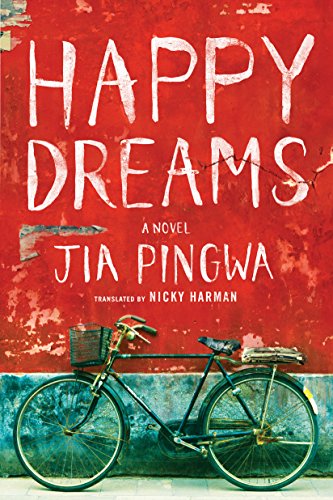
Happy Dreams, by Pingwa Jia
Translated by Nicky Harman
(2007, translated 2017)
(Novel)
Jia Pingwa set himself the goal of writing about the migrant workers who eke out a living in Xi’an as trash pickers. Jia was struck by the ubiquity of these impoverished beings who kept the city clean and powered a dynamic recycling economy. Who were they? Who is responsible for them? The narrator is a man from the countryside. Already in his thirties and unmarried, he sells a kidney and sets off with his friend Wufu to make their fortune in the big city. He has not had much luck in his life thus far, so he decides to change his fate by changing his name to “Happy.” He also rationalizes his move to Xi’an as a homecoming: from his perspective, if his kidney made its way to Xi’an, it proved that he was fated to thrive in Xi’an as well and that he could now take pride in being a full-blooded member of Xi’an society. He and his friend Wufu are an effective team and once they get their hands on a hand scale that will always give them a small advantage in a trade, they begin making enough to establish a “patch” or territory that they control and purchase a bike and three-wheeled bicycle cart. They scour the city every day except when it rains–and trade in newspapers, magazines, cans, construction site refuse, copper wire, bricks, etc. Happy purchases a pair of women’s high heels and puts them in a place of honor on a shelf over his pallet, believing that one day he will find a woman who will fill those shoes. In time, he meets Yichun, a beauty parlor masseuse/prostitute. An exceptional beauty, she has recently been “discovered” by “Mighty,” a mid-level investor in construction schemes. He pays her at a higher rate and introduces her to his friends. She too is a migrant worker who came to Xi’an to make money, but her story is complex. Back home, she was involved with an abusive boyfriend who beat her whenever he drank. One night her brother came to her defense and beat the boyfriend back. He returned later and murdered Yichun’s brother. Her boyfriend fled to Mongolia, and since that time, Yichin has been selling her body in order to pay the police to search for the killer and bring him to justice. Of course, the police are taking advantage of the girl. The brother always manages to escape and the detectives insist they need more money to continue the investigation. Corruption and exploitation are common themes in the novel. Everyone is running cons on everybody else. Though Happy is no innocent, his love for Yichun is sincere and he is good at heart and willing to sacrifice for others. His relationship with Wufu is exploitative. Wufu is large and strong, and he is intensely loyal to his wife, to whom he sends a significant portion of his savings. However, he is uneducated, illiterate, and only knows enough math to keep him from being swindled. Happy puffs himself up by ordering Wufu about and commenting on his friend’s ignorance, ill manners, and poor hygiene. Wufu trusts Happy implicitly, works tirelessly, and has a knack for making good contacts and sharing the sources of valuable refuse. At five hundred pages, the story wanders along. We meet the greedy Eight, the philandering Lively, the coarse and seductive Almond, and a slew of nameless traders, thugs, and policemen. They end up having to pay protection money to a head picker and when the city decides to crack down on immigrants they have to run from roving bands of “scouts” who patrol the streets searching for outsiders, whom they beat mercilessly. Pingwa revised the novel five times, ultimately deciding to strip it of any outright social commentary or any “writerly” language, with the goal of creating a novel that sounds like it was created by the people who inhabit it. The language is coarse to the point of being grotesque, the vocabulary is simple, and both Pingwa and the translator succeed in rendering different regional accents. Perhaps the novel might benefit from editing out one hundred to one hundred and fifty pages, but during the heart-rending six chapters of the denouement, I was more than pleased that I stuck with the work. Those interested in learning more about the novel and its writer might want to read the epilogue which can be found for free online under the title “Happy and Me.” Pingwa explains the original idea behind the novel and also explains that his character “Happy” is modeled after a real person. He also explains his efforts to learn more about the trash-picking community, and the recounting of his struggle to present these people with honesty and empathy is well worth reading.
“Mother Wang had said I had to build a new house, so to raise the money, I sold my blood. I did this three times, until I heard that people from Dawanggou had caught Hepatitis B from selling their blood, so I didn’t do that again, I sold my kidney instead. I used the money to build the house, but then the girl went and married someone else. OK, so she married someone else. I still played the flute for three days and nights, and then I went out and bought a pair of women’s leather high-heeled shoes with pointed toes. ‘You bunion!” I said. “I’m going to marry a woman who wears leather high-heeled shoes with pointed toes!’”
 East Asian Literature in Translation