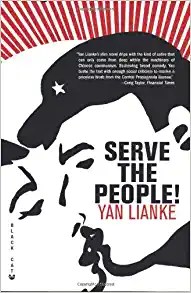
Serve the People! by Yan Lianke
Translated by Julia Lovell
(2005, translated 2008)
Black Cat
(Novel)
Serve the People! is one of Yan’s earlier works and one of the first to be published in translation. The story is relatively simple. It is 1967. Mao’s control over his people and his cult of personality is at its height. A young man from the country, a soldier, Wu Dawang, marries for security and to appear a proper candidate for advancement through the ranks. He throws himself into his work with revolutionary ardor. He chooses to become an Army cook because soldiers in this career often found themselves promoted quickly. As hoped, his culinary skills as well, as his ability to quote and even punctuate the entire contents of The Quotations from Mao Zedong, bring him to the attention of the Division Commander, who declares Wu a Model Soldier and scoops him up to provide meals for him and his wife. Wu Dawang becomes a fixture at the stand-alone, gated private home on the military base. When the Division Commander is called to Beijing, Wu Dawang continues to serve his boss’s wife, the alluring and commanding Liu Lian. While Wu cooks, cleans, and does the laundry, all while rehearsing the commands of the Great Helmsman, Liu Lian embarks on her own campaign of seduction, the first step of which requires her to teach Wu the true meaning of Mao’s great speech “To Serve the People.” Although Liu Lian’s subtle reinterpretation of the slogan is revolutionary and a terrible corruption of Mao’s vision, Wu begins to comprehend that Liu Lian’s desire to be served sexually is merely the embodiment of the truth that motivates everyone in China, each of whom is desperately trying to work the system, gain an iota of privilege, and advance from a miserable life in the country for a chance to get residency in a major city. The Chinese government banned Yan’s book for its politics and called it pornographic. The sex in the novel is somewhat explicit, but it is all part of the satire. Mao’s “Serve the People!” speech is published in its entirety at the end of the novel.
“Though Wu Dawang didn’t know who the Division Commander meant by ‘them,’ he did know, and better than most, the People’s Liberation Army’s three rules of thumb–Don’t Say What You Shouldn’t Say, Don’t Ask What You Shouldn’t Ask, Don’t Do What You Shouldn’t Do. He therefore went back to the kitchen to prepare soup for the Commander and his wife. And from that moment on, the sign [Serve the People!] became the most distinguished, most illustrious resident of the dining table, casting its mighty symbolic shadow over the lowly bottles of vinegar, chili sauce and sesame oil.” (3)
 East Asian Literature in Translation