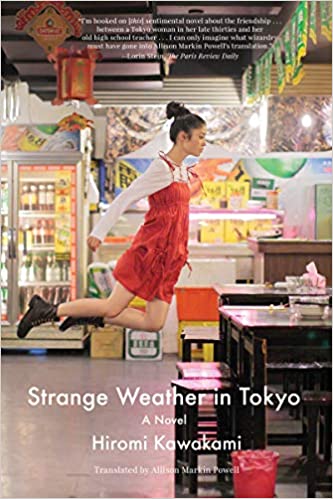
Strange Weather in Tokyo, by Hiromi Kawakami
Translated by Alison Markin Powell
(2012, translated 2017)
Counterpoint
(Novel)
As in the Ten Loves of Nishino, Ms. Kawakami focuses on the topics of love and loneliness in modern, urban Japan. Her heroine, Tsukiko, is a thirty-eight-year-old woman. She works in an office; she is unmarried, single, and lives a drone-like life. Taking advantage of the looser restrictions on women in contemporary Japan, she assuages her loneliness by frequenting bars where she tries to disappear into one, two, or three bottles of sake an evening. One night, she recognizes her former high school literature teacher, a man of sixty-eight. Off and on, they bump into one another, drink together, and talk of their love for food. Over time, her former teacher, whom she refers to throughout as Sensei, tells her how his wife left him. Another time, he tells her about his wife’s death. They argue about sports, give each other small gifts, and eventually fall in love. This May-December romance, one that exists free of sexual desire or attraction, seems to be a popular sub-genre in Japan. Though a short novel written in spare prose, their love develops as slowly and organically as a George Elliott romance of three times the length. Though we might be concerned about their age difference and the way the relationship often echoes the dynamic between teacher and pupil, Kawakami leans into the taboos and celebrates a sweet and subtle romance that is as genuine as it is innocent.
“I wondered who this old man was who shared the same taste as me, and an image of him standing at a teacher’s podium floated through my mind. Sensei had always held an eraser in his hand when writing on the blackboard. He would write something in chalk, like the first line of The Pillow Book by Sei Shonagon: ‘In spring it is the dawn that is most beautiful.’ And then, not five minutes later, he would erase it. Even when he turned to lecture to his students, he would still hold on to the eraser, as if it was attached to his sinewy left hand.”
 East Asian Literature in Translation