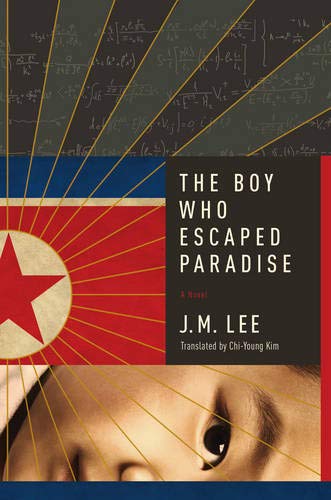
The Boy Who Escaped Paradise (2016)
By Lee Jung-myung
Translated by Kim Chi-young
Pegasus Books
(Novel)
The Boy Who Escaped Paradise has much in common with 21st-century South Korean cinema, in that it is a mashup of genres including (at least!) a murder mystery, a thriller, an escape story, and a love story. Ahn Gil-mo, the prime suspect in a murder of a North Korean defector in New York City, was born in Pyongyang, the only son of a doctor who ran afoul of the Kim regime and found himself first demoted to a mortician and then imprisoned in the North Korean gulag. His son, Gil-mo, has Asperger’s syndrome; he is also a maths prodigy. He escapes the prison, survives life on the streets in a North Korean border town, and eventually crosses the Tumen River into China. His picaresque adventures follow a relentless pattern: almost always living as an impoverished illegal, he stays alive in society’s margins, where he inevitably is discovered by criminals who use his talent with numbers to their advantage. After being used as a drug mule, he winds up in Shanghai where he keeps the books of a mob boss. From there he is off to Macao, then to South Korea, and finally to Mexico and the United States. Lee’s character is a contradiction. He loathes being touched, seems completely unaware of the value of money, struggles with the concept of right and wrong, yet is also driven by a desire to carry through on promises to honorable men he meets on the way. He also never stops searching for a girl he met while in the North Koren prison camp, an extraordinarily beautiful creature who can not only comprehend his high-level mathematical thing but also speak with him in a language he invents that is based on five different languages and his idiosyncratic interpretations of mathematical symbols and number sequences. Lee Jung-Myun packs his novel with allusions to The Odyssey and many, many mathematical thought pieces, but in the end, The Boy Who Escaped Paradise is a pop-fiction page-turner that doesn’t want its readers to ask too many questions, though it is easy to imagine that a movie based on the novel is imminent.
“I was born in 1988, the year after the 105 Building was born; but neither of us were completed. The building was scheduled to be finished in April 1992, to commemorate the Great Leader’s eightieth birthday, but the French joint engineering team left Pyongyang in May 1989, after the outer frame was constructed. The exterior was eventually finished, but the interior stayed empty, like me.” (13)
 East Asian Literature in Translation