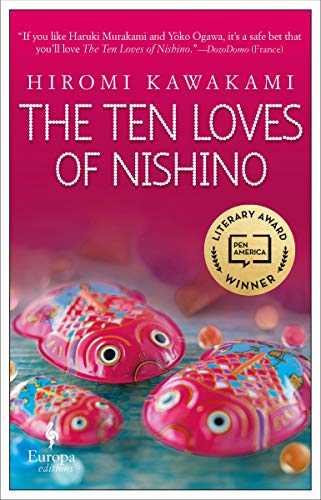
The Ten Loves of Nishino, by Hiromi Kawakami
Translated by Alison Markin Powell
(2003, translated 2019)
Europa Editions
(Novel)
Ms. Kawakami’s novel is ostensibly about Yukihiko Nishino, a man who seems to be all things to all women. He may be a cipher, someone incapable of love, a womanizer, or he may be someone desperately searching for an end to his isolated existence. Kawakami writes about Nishino from the perspective of ten very different women who have affairs with him throughout his life. Each woman reveals their attraction for Nishino, as well as the ways they find Nishino a mystery. Many of the women have been in failed marriages or romances; they are wary of being hurt, but they also seem to be trying to determine if they are capable of opening themselves up emotionally to a new love. In spite of desires and passions, in story after story, the female narrators reveal that they are unable to commit to marriage, in part because they believe themselves incapable of experiencing and sustaining love, or because they see marriage as antithetical to love. For many, love is a will-o’-the-wisp, a certain quality of light that is there and then gone. Each of the women is fully formed as an independent and unique character, and sometimes the only common trait they share is an abiding curiosity about the ghost-like Nishino, who is portrayed as an enigma right up until the point where the great wound from which he suffers is revealed. I rather wished Kawakami had not pulled back the curtain on her pathologically unsatisfied lover. It should be noted that the cause of Nishino’s struggle with love is related to a universal taboo. Kawakami thus partly resolves our reader’s curiosity about an extraordinarily conflicted man, but ultimately we are left to wonder about the tenacious love anxiety suffered by the ten ordinary women who were Nishino’s “lovers.” In the end, they are the more interesting stories.
“A strange air drifted about Nishino. An air that none of the other kids in class had. I had the impression that, if I were to try to push that air around, there would be no end to it. The more I tried to push it, the deeper I would get caught up in it. And no matter how hard I pushed, I still would never reach Nishino on the other side. Nevertheless, there was something gentle and warm and pleasant about that air. And, imperceptibly, it seemed to create the illusion that the air itself was Nishino, instead of the person.” (“In the Grass”)
 East Asian Literature in Translation