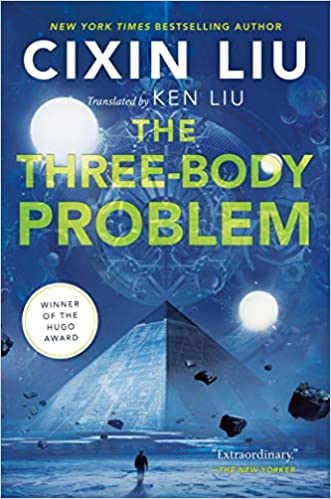
The Three-Body Problem, by Liu Cixin
Translated by Ken Liu
(2006, translated 2014)
Tor Books
(Science Fiction)
Liu Cixin is China’s most prolific and successful writer of “hard” science fiction, which is based on scientific accuracy and logical thinking. His 2000 novella The Wandering Earth was turned into a 2019 blockbuster movie directed by Guo Fan. Liu’s The Three-Body Problem is the first entry in the eponymous trilogy which includes The Dark Forest and Death’s End. The story has its roots in the final years of the Cultural Revolution as Ye Wenjie, a young astrophysicist, witnesses her father’s death during a struggle session in which her own mother and younger sister join in condemning her father. Refusing to lend her voice to the criticism, she is labeled a traitor and rusticated to inner Mongolia, where she works clearing trees for large-scale agricultural schemes. As she witnesses the developing ecological disaster, she is slipped a copy of Rachel Carson’s A Silent Spring, a forbidden capitalist text. When the person who gave her the book betrays her, she is condemned to death. However, the military intervenes because they discover a speculative paper she wrote several years before on the physics of radio waves. Ye is put to work at project Red Coast, a program for using microwaves as a weapon to destroy enemy aircraft. But Red Coast is also a signaling center and listening post for interstellar communications. In the present, we meet Wang Miao, a practical physicist working in nanotechnology whose team is attempting to manufacture extraordinarily strong fibers that are all but invisible to the naked eye. He is also a self-taught photographer who has recently found success in the art world, and while shooting one day, he discovers a set of numbers appearing in his camera and film that appears to be a countdown timer. He runs a number of experiments and realizes that the numbers only appear when he is using the camera–or when he is using any camera. His anxiety peaks when he begins seeing the numbers counting down in his eyes, whether awake or asleep. Terrified, Wang begins to suspect that the nightmare he is living is connected somehow to an outbreak of suicides among the highest ranks of Chinese scientists. His efforts to determine the source of the signal that he is receiving lead him to a meeting with Shi Quiang, a police detective, who is also looking into the suicides. These three characters are the human heart of a novel that can be exceptionally cold and opaque, particularly when Wang enters the world of a mysteriously complex computer game called “Three Body,” which challenges players to help conquer an essential problem of physics: the mathematically unsolvable “Three-Body Problem.” Liu eventually presents us with the first contact with an alien race, the “Trisolarans.” His world-building is epic and the science is always imaginative and unexpected, yet he also attends to the complex and unpredictable ways the people on earth react to the news that they are not alone in the universe. Throughout, Liu manages to keep philosophical and political ideas in the mix, succeeding in allowing us to see extraordinary patterns in human and non-human life. For example, one of the most successful strategies of the Trisolarans is their effort to undermine humanity’s trust in science.
“There was no discussion of physics, of relativity, only cold, harsh reality. According to your father, Einstein stood there for a long time after hearing the answer, watching the boy’s mechanical movements, not even bothering to smoke his pipe as the embers went out. After your father recounted this memory to me, he sighed and said, ‘In China, any idea that dared to take flight would only crash back to the ground. The gravity of reality is too strong.’”
 East Asian Literature in Translation