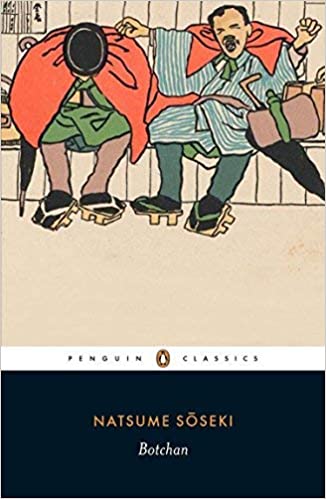
Botchan, by Soseki Natsume
Translated by J. Cohn
(1906, translated 2005)
Penguin Classics
(Novel)
Although the initial scope of this project was to look at East Asian Literature from the mid-twentieth century to the present, it is important to include Botchan as it is still a popular standard in Japanese literature classes; Japanese students will bring up Botchan when they first meet Holden Caulfield in The Catcher in the Rye. “Botchan” is the nickname of the protagonist, a young man who has just graduated from college and taken a position as a maths teacher in a small town. The nickname, Botchan or “Master darling” is significant: the hero is a disappointment to his parents. He fights, he schemes, and he doesn’t take his schoolwork seriously. He will call out anyone for hypocrisy, no matter how large or influential, and if he goes down for his beliefs, he will go down fighting. His older brother toes the line, and though he is no genius, his parents shower him with praise and attention. Botchan might have been forgotten entirely were it not for the influence of the family’s middle-aged maid, Kiyo, who takes a liking to the young scrapper. Kiyo, who embodies the values of an earlier age, appears to see great potential in the boy, and she supports him unfailingly, praising his outspoken sense of personal honor and justice. She alone calls him “Master darling,” and our hero adopts her idea of him as both his identity and nom de guerre. Even when he is off in the country trying to get to the root of the complex internal politics that make his work at the middle school a minefield, he thinks constantly of his debt to his mentor, vowing that as soon as he can earn a decent salary, he will hire loyal Kiyo to return to his service. Until that time, he must determine whom in the faculty he can trust, where he can find a landlord who will not try to take advantage of him, and how to manage an army of irresponsible but well-connected students. Botchan is a coming-of-age story about a twenty-something young man who is trying to determine who he will be as a professional, but it lacks a traditional love interest. Though he works to undermine a love triangle between two teachers and a geisha called the Madonna, Botchan himself shows no desire for erotic love; his passion seems to be for justice, exposing hypocrisy, and reuniting with the one person who believed in him: old Kiyo, who in some respects, stands for the moral intensity and the class certainty and loyalty of the Tokugawa period.
“When you think about it, you really have to hand it to somebody like Kiyo. She was just an old woman without any education or social standing, but as a human being she was really noble. Even though she’d done so much for me, I’d never felt particularly grateful to her before, but now that I found myself on my own so far away from home I finally realized how kindhearted she’d been.” (41)
 East Asian Literature in Translation