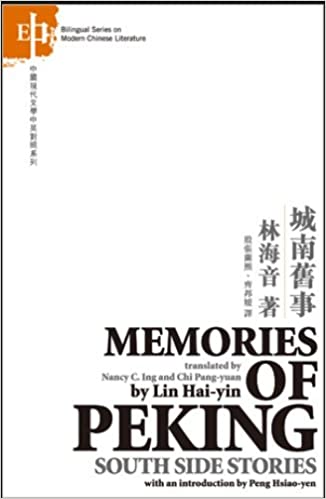
My Memories of Old Beijing: South Side Stories, by Lin Hai-yin
Translated by Nancy Hi-Ing and Chi Pang-Yuan
(1960, translated 2002)
The Chinese University Press
(Memoir)
Ms. Lin’s stories of her early childhood in Beijing in the 1920s and 1930s are full of vivid characters who people the hutong or narrow alley of traditional courtyard residences—a type of housing that is rare in modern Beijing. The stories are told with a child’s innocence, yet young Lin continually returns to the theme of justice and morality. Against the warnings of her family, she is drawn to the home of a reputed lunatic woman. Lin befriends the woman and joins her in long talks about her lost daughter, with whom she continues to interact, though she died many years before. She also becomes close with a child her own age, as well as a homeless thief who is stealing from the families in the neighborhood. The memoir ends with the death of Lin’s father.
The biography of Lin Hai-yin in some ways reflects the complexity of life as a Chinese in the 20th century. Her family was Han from Taiwan, but Lin was born in Japan, where her father worked as a merchant. Her family moved to Beijing when she was five years old. She graduated from the News and Broadcast Institute and became a journalist. In 1948, Lin moved to Taiwan with her husband, where she continued to write, producing twelve books, including novels and collections of short stories. Many Chinese students entering year nine English have strong, positive memories of My Memories of Old Beijing: South Side Stories, which they consider sweet and heartbreaking. A special note: In 1983, director Wu Giyong produced a film version of Lin’s story called My Memories of Old Beijing. The 96-minute movie was selected to represent China at the 56th Academy Awards for Best Foreign Language Film and is considered one of the classics of Chinese cinema.
“Mama was sitting beside the stove combing her hair. Bending over slightly, she drew a handful of hair from the back of her neck over her shoulders, and using a fine-toothed comb, she began slowly combing over and over again. There was a bottle of rose-colored hair oil sitting on the stove for it was so cold that the oil would freeze and had to be melted before it could be used. It was very bright outside. Perched on the bare tree branch were several little birds who were unafraid of the cold. I wondered to myself, when would the tree be covered with leaves again? This was our first winter in Peking. Mama still could not speak Pekingese very well. She was telling Sung Ma what to buy at the market today and she could not say, ‘Buy one catty of pork, not too fat.’ What she said sounded like, ‘Buy one catty of bark not to fly.’” (“Hui-An Hostel”)
 East Asian Literature in Translation