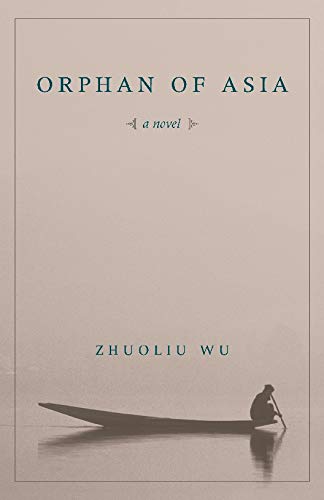
Orphan of Asia, by Wu Zhuoliu
Translated by Ioannis Mentzas
(1945, translated 2005)
Columbia University Press
(Literary Memoir)
Wu Zhuoliu’s Orphan of Asia is a classic of 20th-century Taiwanese literature. Although published at the end of the Great War of the Pacific in 1945, Wu’s novel was only translated into English in 2005. One reason for the delay is that Wu’s protagonist and narrator, Hu Taiming, is so perfectly a representation of what it meant to be Taiwanese during the Japanese occupation: Orphan of Asia is written in Japanese, while also featuring Mandarin, Cantonese, rural Taiwanese dialects, and poems composed in classical Chinese. The variety of tongues as well as Hu’s ability to navigate his way through this polyglot world is part and parcel of the great challenge of following his long journey of self-discovery. Hu is mentored and educated by his grandfather in a rural school. The old man teaches the boy Chinese and they read together from classic Chinese poetry. But the village is run by the Japanese, and the boy quickly feels pulled between the two cultures. He loves his grandfather, but his parents and the community pressure him to learn Japanese. Responding to pressure from the imperialists, Hu pins the hopes of his family’s success on assimilation and like many Taiwanese, imagines a day when Japanese-speaking Taiwanese will be accepted as equals. Academically precocious, Hu travels to Japan where he earns a college degree, and experiences his first love with a Japanese woman who refuses to marry him because he is ethnically different from him. He returns to Taiwan and earns a post teaching at a rural school for girls. He begins to understand the poverty of the land where he grew up as well as its backward education system. He becomes an exemplary educator not only by teaching literature to the girls and women of the community, but also by teaching about hygiene, health, and the basics of western medicine. But Hu also longs to reconnect with his Chinese family and traditions, so he becomes the first of his family in many generations to return to Beijing. Teaching at a university there, he is smitten by a beautiful student who aspires to be a “New Woman.” They marry, and Hu is chagrined to discover that she eschews domestic bliss for the pleasures of the theater and the art world, attracting a coterie of young iconoclastic artists and political activists. As the Japanese army increases its attacks on China and Hu’s associates face arrest, he flees back to Taiwan alone. Hu is reflective by nature. He is at times overcome by depression. He sees his mental state as a great failure, yet his anxiety and his paralyzing moral conflict embody the turmoil that is pulling apart his homeland. By the end of the novel, Hu has witnessed more than enough horrors, reversals, and betrayals. As the Japanese, who vowed to hold Taiwan for a thousand years, abandon the island in abject defeat, Hu emerges from the jungle with the realization that he must set aside his belief in scholarly neutrality and throw himself into working politically to restore the soul of his nation.
“Taiming recalled that four or five days earlier the chancellor of the university and one of the professors had published a piece on Japanese-language education in the newspaper. They argued that in order for the process of colonization to be carried out, the Taiwanese language must be completely eradicated. It was a preposterous notion, unbecoming of any scholar worthy of the name, and spoke volumes about the degree to which these scholars for hire would do anything to toe the party line and curry favor. Considered in this light, this place was indeed the ‘wolve’s den.’” (232)
 East Asian Literature in Translation