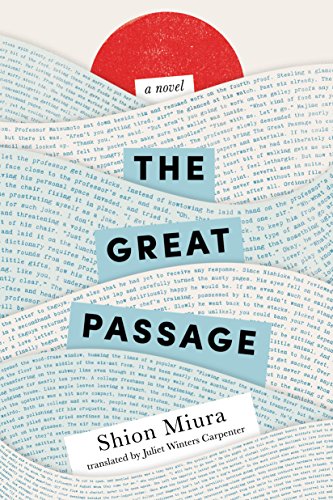
The Great Passage, by Miura Shion
Translated by Juliet Winters Carpenter
(2012, translated 2017)
Amazon Crossing
(Novel)
The Great Passage offers an engaging insight into the Japanese commitment to personal excellence, devotion to the greater good, and collectivism as the nation and its people enter the 21st century. Gembu Books is a mid-sized publishing house in Tokyo that is modern in every way except for its annex, a rarely-visited, dusty place, crowded with antique and second-hand books. There, Gembu shelters a small group of linguists and editors who produce and revise dictionaries. These projects require years of slow, methodical, and painstaking work. Employees at Gembu consider the projects loss leaders, but the company continues to run the division because a successful dictionary raises the overall prestige of the publishing house. For their part, the workers assembling the Japanese dictionary that will be called The Great Passage are fully devoted to making a resource that will preserve the nation’s language and make it possible for people to communicate with one another with greater efficacy, nuance, and beauty. Miura tells the story of the fifteen-year-long project from the perspective of each member allowing these fully-rendered characters to share their experience in their own words. Miura takes us from the kernel of the dictionary to its fruition, introducing us to the veteran editor Araki Kohei and Professor Matasumato, a retired university professor who devotes the final years of his life to his passion for words. Araki is at the end of his career, and both men are concerned about finding a new editor with the mindset, persistence, and skill to carry the project forward. Learning of a likely candidate who works in Gembo’s sales department, they discover Majime Mitsuya, a recent university graduate who holds a graduate degree in linguistics. Majime is an introvert’s introvert, untidy, poor at communication, friendless, and in love with words. Araki and Professor Matsumoto put their faith in this young man, making him the editor of The Great Passage. Initially, the team also includes Nishioka, a garrulous, overconfident womanizer on loan from sales, and a middle-aged divorcee, Ms. Sasaki. As the dictionary comes closer to completion, Kishibe Midori is hired. A low-level editor at a women’s magazine, she was hired to assist with building up the collection of words unique to local and international fashion trends and popular culture. As it happens, she is also instrumental in pushing Majime to change sexist language and to make the dictionary LGBTQ friendly. (Kishibe shares much in common with Miura, who is an outspoken supporter of yaoi manga, which celebrates homoerotic relationships between high school-age young men). Miura also introduces us to the love interests of each of these characters as they pursue their mission. The Great Passage enjoys great popularity in Japan. Ishii Yuya directed a film version of The Great Passage in 2013; an animated series based on the novel appeared in 2016.
“Yet the kind of emptiness and loneliness she’d described applied no less to lexicography. However many words were gathered, however they were interpreted and defined, no dictionary was ever truly complete. The moment you thought you had captured words in a volume, they became a wriggling mass impossible to catch hold of, slipping by you, changing their shape as if to laugh off the compilers’ exhaustion and passion, and issuing a challenge: “Try again! Catch us if you can!” All Majime could do with a word’s endless motion and vast energy was capture it as it was, in one fleeting moment, and convey that state in written form.” (54)
 East Asian Literature in Translation