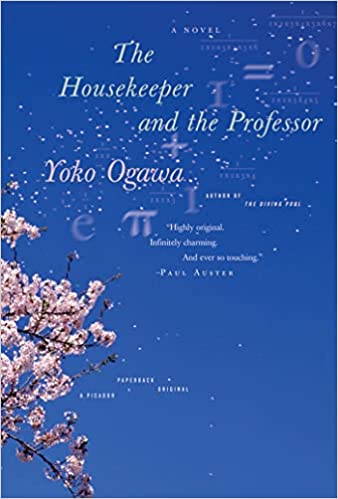
The Housekeeper and the Professor, by Ogawa Yoko
Translated by Stephen Snyder
(2003, translated 2009)
Picador
(Novella)
Like her dystopian novel about institutionalized, nationwide forgetting, The Memory Police, Ogawa’s The Housekeeper and the Professor features a character who is a victim of his own inability to remember anything since a car accident he experienced in 1975—twenty years ago. The Professor’s situation is further complicated because his mind is like a film that can only record eighty minutes of information before it disintegrates and he must begin again. He lives in a run-down cottage at the back of a property owned by his sister-in-law. She manages his care by hiring housekeepers to watch over him. To date, she has hired and fired nine housekeepers, suggesting that the position is exceedingly difficult and that the client is especially troublesome. The single mother who takes the position next is patient and tenacious. She recognizes quickly that the Professor has never stopped being a mathematician and that he interacts with the world using two strategies. When he is confused about a social interaction or ill at ease, he asks questions that can only be answered with numbers, allowing him to explicate exhaustively on the significance of whatever numerical response arises. Thus, he asks people their birthday, their height, and their shoe size. He also uses notes as reminders of anything he notices during his moments of clarity and pins them to his suit, so many that he rustles when he walks. Unlike the cold, resigned, and fading characters in The Memory Police, The Caretaker and the Professor is exquisitely warm and engaging. The housekeeper begins bringing her young son to her work and discovers that the Professor blossoms in the boy’s company. Remarking on the child’s flat head—a point of shame for the boy–, he decides to call him after the mathematical sign he resembles: “Square Root” or “Root.” The mother and daughter soon become involved in the Professor’s two obsessions: mathematics and baseball, becoming something of a family. This is the first of many books from East Asia I encountered that focused on aging and with the disease of dementia.
“He hoisted Root on his back, and though I tried to remind him that the child hadn’t hurt his legs, he ran off to the doctor’s carrying the boy piggyback. To be honest, the ride seemed so rough that I was worried the wound would open up again. It could hardly have been easy for the Professor to carry a sixty-pound child on his back, but he was stronger than I thought…Root pulled his Tiger’s cap down over his eyes and buried his face in the Professor’s back, less from pain than from the embarrassment of being seen.” (68)
 East Asian Literature in Translation