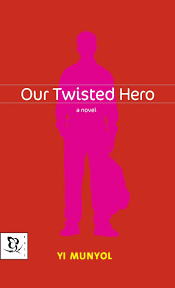
Our Twisted Hero, by Yi Munyol
Translated by Kevin O’Rourke
(1987, translated 2001)
Hachette Books
(Novella)
Mr. Yi is a very well-established writer. According to The Village Voice, “Yi is to South Korea what Amos Oz is to Israel, Nadine Gordimer to South Africa, and James Baldwin to the US.” The story begins with a middle-aged man reflecting on his experience of moving from Seoul to a poorer suburb after his father runs afoul of political infighting in his place of employment. Acutely aware of his drop in status, twelve-year-old Han is nevertheless confident that he will be recognized as a high-status student. After all, he comes from a modern Seoul school, his school supplies are superior to those of his peers, and his grades speak for themselves. Instead, Han discovers that this school, a run-down building of Japanese architecture, is staffed by lackadaisical teachers who, like the students, are under the thumb of a very effective totalitarian bully: Om Sok-dae. For most of his fifth-grade year, Han attempts to resist Om’s influence. However, Om is able to bring incredible forces to bear on the rebellious young man. He eventually succeeds in humiliating Han, completely destroying his resolve to live the life he wants to live. One might think that after his total victory over Han, Om would cast him aside. Instead, he welcomes Han into his circle, boasts of his achievements, and raises the boy’s status. Now co-opted by Om, Han becomes an obedient soldier in Om’s army. The twisted relationship between the two continues until midway through the sixth grade when a new teacher arrives, exposes Om Sok-Dae’s dominance, and cleans house at the school, removing Om as well as the teachers who tolerated his rule.
Bullying is a common topic in American Young Adult novels, but Yi’s tightly focused novella is both a study of bullying and political criticism of the Korean government from the late 1970s through the 1980s. The Gwangju Democratization Movement occurred in 1980; that protest grew after the 1979 assassination of President Park Chung He. Park was replaced by Choi Kyu-hah, but he was merely a puppet. The real force behind the government was the Chief of Defense, Chun Do Hwan. When citizens gathered to protest for democracy in cities around South Korea, General Chun ordered military troops and even helicopters to fire on the civilians. Perhaps more than any other event in the 20th century, that betrayal has had a profound effect on the people of South Korea. If you wish to learn more about the way South Korean artists continue to respond to this event, see the movie A Taxi Driver, Choe Yun’s collection of short stories There a Petal Silently Falls and Im Cho-ru’s short story, “The Red Room.”
“As soon as my mother brought me into the room, the teacher in charge came over to greet us. He too fell far short of my expectations. If we couldn’t have a beautiful and kind female teacher, I thought at least we might have a soft-spoken, considerate, stylish male one. But the white rice-wine stain on the sleeve of his jacket told me he didn’t measure up. His hair was tousled; he had not combed it much less put oil on it. It was very doubtful if he had washed his face that morning, and his physical attitude left grave doubts about whether he was actually listening to Mother. Frankly, it was indescribably disappointing that such a man was to be my new teacher. Perhaps already I had a premonition of the evil that was to unfold over the course of the next year.”
 East Asian Literature in Translation