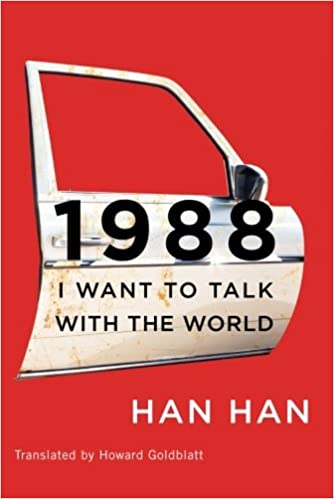
1988, I Want to Talk with the World, by Han Han
By Han Han
Translated by Howard Goldblatt
(2013, translation 2015)
Amazon Crossing
(Novel)
This is a dark, gritty, and melancholy tale written by a very popular novelist and race car driver. Han builds his coming-of-age story around a road trip along one of China’s national highways. His ostensible mission is to travel to a distant city to pick up the narrator’s childhood friend, Ding Ding, who has been serving time for theft. The narrator is picking his friend up in “1988,” a cream-colored station wagon whose engine Ding Ding rebuilt so that the narrator would have something to drive around in. The narrator is rootless and poor; he reminisces about his schooldays, when his world revolved around bullies, pretty girls, larks with Ding Ding, and his dreams of the future. Before launching out on his cross-country trip, the narrator encounters disaster: he stops at the Golden Triangle Massage, spends the night with a prostitute, and gets shaken down by the police at sunrise. In a cliche straight out of American movies of the 60s, he decides to take Shan-Shan with him on his quest to liberate his friend. Shan-Shan seems like “the hooker with the heart of gold,” and she all but calls her rescuer her “white knight,” but they are darker, uglier characters, each concealing truths that, when revealed, are as shocking and repulsive as anything found in this grim Chinese noir. As he journeys through flat industrial landscapes, the narrator regales us with hilarious and heartbreaking experiences as a newspaper reporter and his short-lived love affair with an actress. He breaks down the moral and monetary economies behind prostitution, journalism, and film production in modern China, exposing corruption at every level of society and in every occupation. As the story unfolds, we also learn more about Shan Shan, who goes by Bing Bing and at least half a dozen other aliases. The character is frank about her work and her limitations; a significant portion of the novel is an account of the ways she has been exploited and victimized by Chinese society. She’s on a mission to save money, but as she recounts her adventures, we lose track of the number of times she is tricked out of her money, robbed, and raped. Han uses this character’s body as a testament to China’s ills: Chinese men of every status abuse her, refuse to wear condoms, and leave her with a terrifying list of socially transmitted diseases and when she seeks medical treatment the male doctors only compound her suffering. As bleak as the novel is, it is rich in black humor and hard to put down. Han is also very much a modernist, playing around with genres and formulas in unexpected ways. More than once he presents a device that is patently contrived and amateurish, only to return to it later to reveal the marvel it has become.
“I’ve discovered that the people I’ve admired most in life were the hot-blooded kind. Now, I’m not cold-blooded, more like warm-blooded, but I’ve always loved watching the hot-blooded ones and wished I could become one of them. I’ve discovered that when something stumps me, they’re already trying to work it out in their heads, and by the time my brain kicks in, they’re in action. Then, by the time I take action, they’re on top of things, and I don’t dare go any further. I’ve always looked up to people who can do that. I have an innate respect for them and wish their blood could somehow warm me.” (35)
 East Asian Literature in Translation