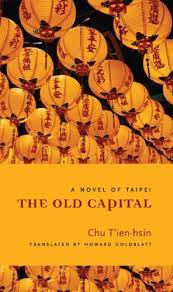
The Old Capital: A Novel of Taipei by Chu Tien-hsin
Translated by Howard Goldblatt
(1997, translated 2007)
Columbia University Press
(Four short stories, one novella)
Chu Tien Hsin comes from a literary family: both her sister, Chu Tien-wen, and her father Chu Hsi-ning, are established Taiwanese authors. Chu writes dense, allusive stories packed with fine grain detail of daily life combined with high-flying references to East Asian and European authors and pop culture. Her writing is therefore very challenging; one wishes this particular “novel” contained a more thorough collection of endnotes.
“Death in Venice”
“Death in Venice” starts off in a conversational, jocular tone: “Hey, don’t worry, nobody dies and nothing happens” (1). The narrator is a writer of some success who is battling a chronic case of writer’s block. He explains that his modus operandi is to seek out and discover coffee shops that are conducive to particular creations. One of the challenges he faces is that cafes go in and out of business quite frequently in Taipei and redevelopment schemes are forever consuming the old guard. Likewise, the modern shops that appear overnight are either soulless franchises or independent shops that feature themes so overwrought that they cause the writer to automatically churn out stories appropriate to the English countryside or a French arrondissement. He also brags about winning a literary award that allowed him to take a packaged tour of Venice, which causes him to reflect on a philosophical problem or truth: which is real? Venice, or the Venice of the mind? The narrator cites his naturalist mentor, Meng Dongli, as well as Marx, Popper, Marcuse, Thoreau, Mann, Marquez, Blake, and Rilke; the more he speaks the more we realize that his erudition may be the most significant obstacle to completing the short story he has been hired to produce.
“After that I frequented a coffee shop with decades of history, run by an old Shanghai fellow, and I was surprised to find it crowded with immaculately decked-out elderly patrons with fancy canes, who conversed in loud Shanghainese when they weren’t reading a newspaper. After a couple of days, I knew how to say “money” and “me” just like a native.” (13)
“The Man of La Mancha”
Artists are occasionally consumed by the fear of their own mortality. Perhaps moved by a near-death experience, they reflect on their identity, how they will be remembered by friends and family, what they will leave behind, and what awaits them. This narrator, after consuming six cups of coffee in a cafe and standing up too quickly, collapses on the street. Or more accurately, almost collapses. He has enough presence of mind to ask for help from a passing student nurse and is dispatched from a hospital after a few hours on a saline drip. The arrhythmia is far from fatal, but it sets the narrator to thinking about death and planning in earnest for the eventuality that as a single person, he will be found by a stranger. Were the narrator an employee of the government or business, he would carry an ID card, but as a writer, it is likely that no one will ever be able to determine who they were.
“Underwear is very important. It is not enough to keep it from becoming tattered or turning yellow. On psychological, social, even political levels, it describes the owner more vividly than many other things. Didn’t Bill Clinton respond shyly that his underpants weren’t those trendy plaid boxers, but were skin-hugging briefs? And just look at his foreign policy!r and all things considered, be unidentifiable.” (36)
“Breakfast at Tiffany’s”
The narrator is a single woman in her thirties who is decidedly not looking forward to Valentine’s Day. She knows what will happen: bouquets will suddenly sprout on the desks of her single and married colleagues, and office gossip will suffer a wave of chatter about the generosity and passion of the “lovers.” The narrator has read that there is a new trend among single office workers of a certain age, who, having worked diligently for many years and saved responsibly, purchase a diamond engagement ring for themselves. The ring serves as a reward and also signals to others that “This woman is valued.” Indeed, they are known as “two carat ladies.” The narrator debates this strategy carefully, appearing to have researched the entire history of the giving diamonds from the point of view of miners, gemmologists, advertisers, sociologists, and the de Beers corporation. Coincidentally, she is also sent to interview an accomplished environmental writer in her fifties who has her own agenda: she wants to meet someone of this generation, a representative of what the “national leader” calls “the new humans.” Is the narrator a true representation of “the new humans”? Despite her encyclopedic knowledge of fine gemmary, she knows nothing of her nation’s politics.
“It turned out that the place offered more than just jewelry ( which I discovered by gazing at the window day in and day out). There were silver pen and pencil sets, tableware, exquisitely hand-painted pottery and porcelain, wristwatches, silk scarves, all false needs created by commodity aesthetics; before the curtain rose, I’d truly felt that I had everything I needed, but now thanks to my desires, I felt I had nothing.” (54)
“Hungarian Water”
The title refers to the early European term for perfume. The story features a relationship between two middle-aged men who come together over a mutual anxiety: they fear that as they age they will continue to lose their memories of their most beloved friends, relatives, and lovers. The one has discovered that the key to memory is scent; he shares this discovery with his new acquaintance after he smells citronella on him and is transported back to his youth and his beloved Aunt. The narrator is prickly; he has no desire to make a new friend at his age, but the two become a pair and they begin sharing more and more complex scents and increasingly intimate details about their lives. Once he becomes aware of the power of scent to stimulate memory, he delves deeper and deeper into his past, seeking out the names and faces of his earliest attractions and friends, until he comes across a long-buried memory. Chu’s characters are informed by Proust and Süskind’s Perfume.
“Violet, Chinese lantern, orange, day lily, it was almost as if I could smell them more clearly from how they sounded, and they sparked memories, often appearing on the specials menu at the coffee shop where I passed the time at dusk during rush hour, the ingredients of flavored tea called Star of the Desert, which the girls mixed, treating tea like a perfume by giving it a name.” (88)
“The Old Capital”
Chu’s novella is dense, meandering, intensely rooted in the reality of place and street names, yet overwhelmingly disorienting as the narrator is a native of Taipei, a colony where waves of occupiers have left their imprint on the geography not only with place names in different languages but also plants and trees from different parts of the world. To complicate matters further, the narrator is an adult, a married woman with two grown daughters who is on a mission to meet up with a girl she knew in her youth. As she reflects on her childhood, she wanders through old neighborhoods in Taipei that have suffered renovation or outright urban renewal. The streets she played on in her memory are no more, and she realizes that each new ruling party has not only renamed streets but also cut down the trees she knew as a child and replaced them with foliage that represents their ideal vision of the Taipei spirit. Chu doubles the complexity by having her narrator visit Japan. Once again, the narrator struggles to match the modern cityscape to the one of her youth. To confuse matters further, the author relates this information so that the reader becomes uncertain whether the narrator is describing Taipei or Japan. How could that happen? The Japanese colonizers looked at Taiwan and saw geographical features, religious sites, and transportation routes that reminded them of their homeland. In writing new maps, they simply changed the Taiwanese place names to Japanese, turning Taiwan into a place that was neither Taiwan nor Japan. Readers familiar with Friel’s Translations, a play about the British mapping of Ireland, will recognize the way the renaming of places can fracture a citizen’s connection to their identity.
“In Governor General Nogi’s time, the Imperial Council decided, on advisement, to build the shrine in Taipei, Taiwan’s control center. Tainan and Keelung had both been considered. The reason for the final decision was: if the ancient city of Taipei was to be considered the site of the imperial residence, then the Keelung River would be the equivalent of the Kamo-gawa and Jiantan Hill would be Higashi-yama, making the geographical location of the Taipei Basin a simulacrum of Kyoto.” (204)
 East Asian Literature in Translation