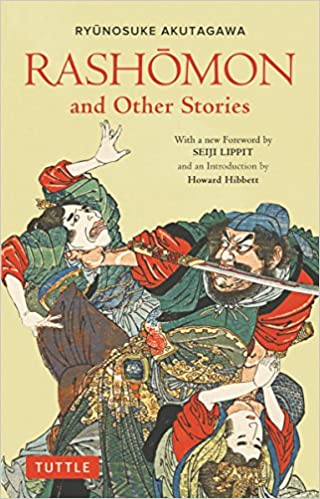
Rashomon and Other Stories, by Akutagawa Ryunosuke
Translated by Takashi Yojima
(1921, translated 1952)
Tuttle Classics
(Short Story Collection)
“In a Grove”
Akutagawa is considered the father of the modern Japanese short story. “In a Grove” and “Rashomon” are the short stories that inspired Akira Kurosawa’s classic psychological thriller of 1950, Rashomon. The conceit is that a crime has been committed on a remote hillside—a samurai has been found dead. The cause of death was a stab wound, though no weapon was found. The reader hears the testimony of six witnesses and is left to determine the fate of the accused and bring justice to the victim. Two witnesses, a woodcutter, and a priest, provide the first reports. The woodcutter came upon the deceased in the woods. He saw no knife, only a severed rope. The priest saw the deceased earlier on the road. The victim was leading a horse on which a woman—presumably his wife—road. The victim was clearly a samurai; he was armed with a sword and carried a bow and a quiver of at least twenty arrows. The third witness is a police officer. He arrested a notorious robber and rumored rapist whom he found unconscious on the road. He had in his possession a quiver with seventeen arrows, near his body was a horse of great value. The fourth witness is the mother of the young bride of the murdered man. She is in agony, for, as yet, no one has determined the whereabouts of her nineteen-year-old daughter. The fifth witness is the notorious robber. He boastfully describes his attack on the married couple, detailing how he tied up the samurai, assaulted his wife before him, and then fought a ferocious battle with the samurai and killed him. Several days later, the bride is discovered, found in prayer at a nearby temple. She too is brought before the justice and asked to tell her story. The stories overlap, to some extent, but some things just don’t quite match up. In the end, “resolution” comes from a supernatural source: the testimony of the dead.
“Yesterday a little past noon I met the couple. A little puff of wind blew, and raised her hanging scarf, so that I caught a glimpse of her face. Instantly it was again covered from my view. That may have been one reason; she looked like a Bodhisattva. At that moment I made up my mind to capture her even if I had to kill her man.” (97)
“Rashomon”
“Rashomon” is a disturbing study of good and evil told in a landscape that seems almost post-apocalyptic. A homeless, exhausted man is caught in a torrential rainstorm. Friendless and without a cent to his name, the man seeks shelter in a dilapidated rashomon, an abandoned structure that long ago served as one of the gates of Kyoto, a city that has suffered a catastrophic economic collapse. Once out of the rain, the man debates again an essential question: reduced to poverty and lacking any source of support, how will he go on living. As the rain continues to fall, he becomes more certain that he must either become a beggar or a thief. Can he lower himself to beg? Can he abandon morality and live a life of crime? He discovers a staircase within the structure and ascends, coming upon a large room. The rumors are true: the poor—and perhaps robbers, too–have been disposing of the dead by abandoning them in this upper room. The stench is horrible. A candle burns in the dark: an old woman, all but toothless, sits by the head of one of the dead souls, drawing out long black hairs from its scalp. Is she a human, a witch, or a demon?
“Flocks of crows flew from somewhere. During the daytime these cawing birds circled around the ridgepole of the gate. When the sky overhead turned red in the afterlight of the departed sun, they looked like so many grains of sesame flung across the gate. But on that day not a crow was to be seen, perhaps because of the lateness of the hour. Here and there the stone steps, beginning to crumble, and with rank grass growing in their crevices, were dotted with the white droppings of crows.” (27)
“Yam Gruel”
Akutagawa takes us back in time to Kyoto in the Heian period, some eleven centuries ago. He introduces us to a low-caste fifth-rank samurai. As he is a member of the Goi class, Akutagawa assures it is best that we simply call the ill-fated man “Goi.” Goi is short and hunchbacked. He possesses no undergarments and his headpiece and kimono are discolored by grease. His sword is unremarkable, and his face is dominated by a bright red, bulbous nose and an impossibly threadbare moustache. Higher-ranked samurai use the man as the butt of jokes and pranks, and the men over whom he should have some authority ignore his orders. Even children mock him. Responding to all this abuse with some level of equanimity, Goi will only venture to ask “Why do you do this to me?” Alone in the world, Goi has but one organizing desire: a passion for yam gruel, a dish that is only available to him once a year at festival time. And because of the communal nature of the feast, he must be content with only so much of this delightful food. When the samurai discover how much Goi relishes the taste, the samurai Toshihito invites the poor man on an exhausting quest to find the best yam gruel, a journey that will involve a speaking fox, shapeshifting animals, and a feast unlike anything Goi has ever experienced.
“But Goi was utterly insensible to this ridicule. At least to the eyes of onlookers he seemed insensible. Whatever others said to him, his expression remained unchanged. Silently stroking his thin moustache, he went on with his daily chores and seemed no more wounded than a duck thrown into a pond.” (37)
“The Martyr”
Akutagawa claims to have found the “bones” of this story in an old collection of the lives of saints of early Japanese Christianity. This particular story, which he retells in beautiful language, he claims has its origins in the movement that founded the 17th Church of Santa Lucia in Nagasaki. According to Akutagawa, the source document appears to be handwritten in Japanese by a witness of the miracle described in the text. Those familiar with the literature of the lives of the saints will find themselves on familiar ground as Jesuit fathers adopt an abandoned child, name him Lorenzo, and raise him among their order. As the child matures, he displays an uncanny beauty as well as a passionate commitment to a religious life. However, as Lorenzo enters his teens, his mentor and friend is alarmed to discover what appears to be a growing intimacy between Lorenzo and the daughter of a local umbrella maker. When the young woman becomes pregnant, suspicion falls on Lorenzo. Despite his protestations of innocence, the order excommunicates the boy and he becomes an outcast in the village. As previously mentioned, the formula and the names are European. One of the many wondrous surprises for any reader must be the moment a samurai enters what otherwise seems like a drama from medieval Italy.
“The brothers, who were nearby, were amazed at Lorenzo’s heroic action, but remembered his old offense. At once unsavory comments, on the wings of the wind, swept over the crowd of people. One person and another heaped abuse on him, saying, “Indeed a father is a father. Lorenzo, who hasn’t dared come near because of shame for his sin, has just rushed into the fire to save his own child.” (68)
“Kesa and Marito”
As in “In a Grove,” Akutagawa constructs his adventure of lust and murder through the accounts—in separate monologues–of two characters. Marito tells his story as he waits in ambush to kill a man he does not hate for a woman he does not love. Three years ago, Marito fell in love with Kesa. He worshipped her from afar and never acted on his attraction for her. Perversely, when he hears the object of his desire has married, he is consumed with an overwhelming desire to possess her. Kesa is the desired wife. When Marito whispers in her ear, “Let’s kill Wataru,” Kesa feels an almost immediate release from her guilt and conceives a brilliant plan.
“The moon is rising now. I usually wait for moonrise impatiently. But tonight the bright moonrise shocks me with horror. I shudder to think that tonight will destroy my present self and turn me into a wretched murderer. Imagine when these hands will have turned crimson with blood! What a cursed being shall seem to myself then!” (76)
“The Dragon”
“The Dragon” is constructed as a frame story. Takakuni bears the title of a chief counselor of state, but he is also a writer who struggles to invent plots. His solution is to travel throughout the countryside asking local administrators to gather townspeople willing to share local folklore. An old potter agrees to tell the first story, the tale of Kurodo Tokugyo of Nara. Kurodo, it seems, possessed an extraordinarily red nose so large that the townspeople openly referred to him as Hanazo, or “Big Nose.” Though a priest of the Kofuko temple and the leader of many loyal disciples, by nature, the man was prankish. One night, he erected a sign near the Sarusawa pond announcing that on March third a great dragon would rise from the pond. He lingers by the pond in the days that follow, finding great humor in the gullibility of the people of Nara.
“It may well be imagined from the preceding account how miserable Hanazo felt at this sight. But then a strange thing happened, for Hanazo began to feel in his heart that a dragon was really likely to ascend. Of course he was the author of the notice-board, and he ought not to have entertained any such absurd idea.” (99)
 East Asian Literature in Translation