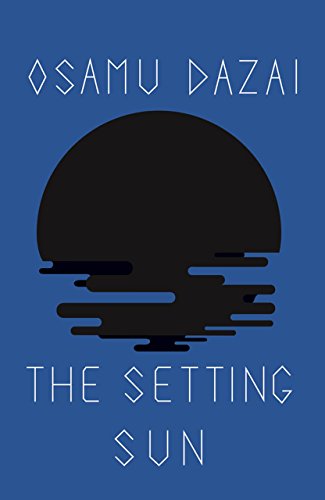
The Setting Sun, by Dazai Osamu
Translated by Donald Keene
(1947, translated 1968)
New Directions
(Novel)
In this novel about post-war Japan, Dazai focuses on the fall in status of a minor aristocratic family. The primary narrator is Kazuko, the divorced daughter of the grande dame of the family, her elegant mother, and her dissolute brother, Naoji. After the war, the family’s coffers are empty. An uncle, Nawada, provides what limited support he can, but the old social structure has collapsed and the family must sell their home and what little they have remaining to move to the countryside. At first, the women fend for themselves, as Naoji had been conscripted and is believed to have been killed in action. The women struggle along; Kazuko works as a day laborer in the fields and comes home to tend to her mother whose health is clearly deteriorating. Miraculously, Naoji returns, unscathed. However, while in service he returned to the drug use that once derailed his high school career. The prodigal is a selfish, cruel being who insults his mother and sister. Although he contributes nothing to the family, his mother is buoyed by his return and fauns over him, to the disgust of his jealous sister. Naoji professes to be a writer; Kazuko discovers what appears to be a manuscript, “Moonflower Journal,” penned by her brother, which she hopes may be a novel. Unfortunately, it turns out to be drug-induced rambling, bitter complaints about the unfairness of life, the falseness of people, and longing for death. It becomes clear that Kazuko’s only hope for survival is to find a husband. Surprisingly, she feels the only man worthy of her love is Mr. Uehara, a much older married man who is a writer and a former teacher of her brother. Kazuko falls in love with the man’s early works and writes him shameless letters of adoration, addressing him as “My Chekhov.” But her love remains unrequited. Six years later, she pursues Uehara again, following his trail from bar to bar, from brothel to flop house. He is a toothless, straggly-haired drunk, a hack who has been just holding on by churning out cheap, titillating, and grotesque stories that might just be pornographic. She once wanted to have a child with this man, and during the night, after resisting his drunken advances for two hours, she yields to him. Later, she reports that she has borne a child out of wedlock; perhaps it is Uehara’s, perhaps not. Kazuko raises the child on her own, envisioning her decision as a powerful political act conceived out of a desire to revolt against what she calls “the old morality” of Japan. As she explains her decision, she blends allusions from economic theory and Marxism, but the primary foundation of her defiance is religious: she sees herself as a new Mary, the mother of a new type of Japanese child and a new Japan. The novel captures the despair of the Japanese aristocracy as they realize their sun is setting; Naoji’s drunken, drug-addled self-pity and self-indulgence certainly embody the fragility and vacuity of the aristocratic lifestyle. What is most difficult to come to grips with is the powerful, manic voice of the narrator. Kazuko at times seems to see a future for herself as a laborer or as a wife, but her increasing religious fervor and her inexplicable attachment to the toxic Mr. Uehara are alarming. In the end, one wonders if she is correct that only a new generation, free of the stain of this period of inhuman violence, will revive Japan, or if her “love” is as addictive and hallucinatory as her brother’s “Moonflowers.”
“The revolution must be taking place somewhere, but the old morality persists unchanged in the world around us and lies athwart our way. However much the waves on the surface of the sea may rage, the water at the bottom, far from experiencing a revolution, lies motionless, awake but feigning sleep. But I think that in this first engagement, I have been able to push back the old morality, however little. And I intend to fight a second and a third engagement together with the child who will be born. To give birth to the child of the man I love, and to raise him, will be the accomplishment of my moral revolution.” (145)
 East Asian Literature in Translation