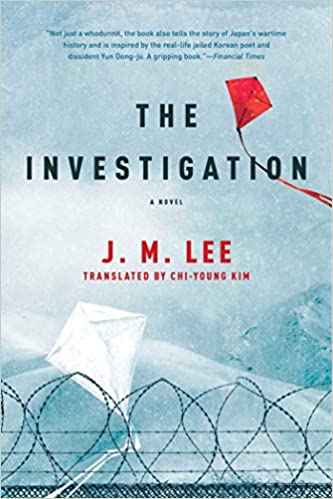
The Investigation, by Lee Jung-myung
Translated by Kim Chi-young
(2014, translated 2015)
Pegasus Crime
(Historical Novel/Crime Novel)
The titular investigation takes place in wartime Japan: Fukuoka Prison, 1942. Sugiyama Dozan, a prison guard rumored to have been the sole survivor of a battle against Russian troops in Manchuria and notorious for the violence with which he treated prisoners, is found murdered. It had snowed the night of his death, and as no footprints were discovered leading into or out of the prison, it is clear that the murderer was an insider. The warden assigns Watanabe Yuichi, a young guard, to investigate the case. From the start, the case is both a locked-room mystery and a study of the power of literature. In addition to being the prison’s enforcer, the dead man was also the barely literate censor. Strange then, that Watanabe discovers a handwritten fragment of a poem on the body of the deceased. A literature major, Watanabe throws himself into the case while also taking on the responsibility for censoring all incoming and outgoing mail. He focuses his attention on the Korean prisoners in Block Three. They are murderers, rapists, thieves, and political prisoners, savages who have taken up arms against the Japanese Empire or conspired to free Korea from Japanese rule. The Koreans must use their Japanese names, speak in Japanese to the prison staff, and all their correspondence must be in Japanese. As Watanabe proceeds with his investigation, he begins to narrow his sights on two suspects, Choi Chi-su, who had both motive and opportunity to commit the crime, as well as Hiranuma Tochu, who is clearly composing all the postcards being sent from Block Three. Hiranuma is a poet who hires himself out to prisoners who want to write letters home. Not only can he write in Japanese, but he also knows how to avoid censorship while also allowing loved ones to understand the true feelings of each prisoner. In time, Watanabe solves the murder and develops a relationship with the Korean poet. Their shared love of literature blossoms, and as they grow closer, Watanabe realizes that Sugiyama also found solace and inspiration in Hiranuma Tochu’s writing and conversations. Side plots abound. A beautiful nurse turns out to be a talented pianist; a noted physician sets up shop in the neglected prison infirmary and his talented staff begins offering the latest medical treatments to the Korean prisoners; prisoners are tunneling hither and yon, and a kite war begins. Lee, who also wrote The Boy Who Escaped Paradise, tends to throw every possible symbol into his novels, almost to the point where they are like a cloud of chaff. Yet as the events taking place inside the prison become more and more extreme, Lee manages to keep the story human. The character of Hiranuma Tochu is unimpeachable; when we discover the extent to which his love for poetry impacted both Sugiyama and Watanabe, it all feels justified, legitimate, and true. And Lee has packed in one more surprise: Hiranuma reveals that his Korean name is Yun Dong-ju. Yun Dong-ju is a real Korean poet who lived under Japanese rule. He published one book of poems in Korea before being sent off to study in Japan, where he died in prison. To this day, Yun Dong-Ju is read in Korean schools and is celebrated as an artist who fought for Korean independence through his poetry. So, among all the secrets hidden in the Fukuoka prison, Lee has also placed a tribute to a great artist and exemplar of the Korean spirit.
“Each line exuded grief and despair and an intense love; each stanza recalled a sad man walking away on a snow-covered road at night. I examined the note carefully–the spot of ink that had spread where the pen had stopped, hesitating; the shape of the clumsy, rapid or slow strokes; the small changes of indentation from pen pressing against paper. Did he write this poem or did he simply copy someone else’s? If this hand wasn’t his, whose was it? Did someone plant this note, and why was this poem in Sugiyama’s pocket? (9)
 East Asian Literature in Translation