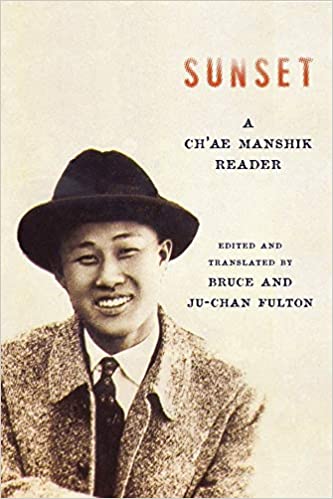
Sunset: A Ch’ae Manshik Reader, by Ch’ae Manshik
Translated by Bruce and Ju-Chan Fulton
(translated 2017)
Ch’ae Manshik, who was a newspaper reporter and editor, was a prolific writer known for his political themes, satirical voice, and clever use of the everyday language of people from all walks of life and in all parts of Korea. In this collection, Bruce and Ju-Chan Fulton present a wide array of Ch’ae’s works, including the novella Sunset, a variety of short-short and short-short stories, the transcript of a discussion among five mid-century Korean writers on the task and purpose of writing, the transcript of a three-way discussion of Kung-Min literature, an essay, and two short plays.
“Sunset” (1948)
The most complete and rewarding of the texts is Sunset, which was published in 1948. The historical scope of the novella is rich material for historians, as it focuses on the end of Japanese colonization, the division of Korea, and the election of Syngman Rhee. Ch’ae’s narrator relates the life story of his larger-than-life auntie, who fled to Seoul after the partition and threw herself on the mercy of the narrator’s family. Though no relation, the narrator’s mother puts up the auntie and the child she carries on her back, and the two women remain in close contact for the rest of their lives. One of the remarkable qualities of the auntie is her tireless rage against the communists, who ransack her home in the north and “redistribute” her assets–material off which she could have lived easily for the rest of her life.
Ch’ae pokes fun at her murderous rage and her vivid fantasy of ROK soldiers obliterating the 38th parallel and crushing the bones of the North Korean devils to dust. As it turns out, she does not want her youngest son in the military to be involved; she prefers that others fight her battles for her. The narrator also reveals the source of the auntie’s lost wealth: her eldest son joined the local police force when he was young–hitching his star to the Japanese colonizers. The vigor with which he executed the agenda of the Japanese earned him rapid promotions, followed by the access, influence, and protection that allowed him to exploit his fellow Koreans through direct theft and more discreet corruption. The narrator learns that after all, the auntie’s self-righteous anger at the North is fuelled by nothing more than greed and resentment over the lost and ill-gotten gains of her quisling son. Ch’ae also includes fine-grain detail about the immediate economic effects of historic political changes:
“And then one day, boom! Liberation was here. The annual yield from our land, after we deducted one-third of the crop for the tenant farmer, dropped from 300 sacks to 200. We had to adjust our annual household budget accordingly. But while our share of the harvest shrank, the prices of goods went through the roof. Adjusting our household expenditures to 200 sacks of grain was only a remote possibility. Why? Because the 200 sacks of rice you sold to the government brought a government-set amount, but what you paid for commodities was the going rate on the private market.” (21)
 East Asian Literature in Translation