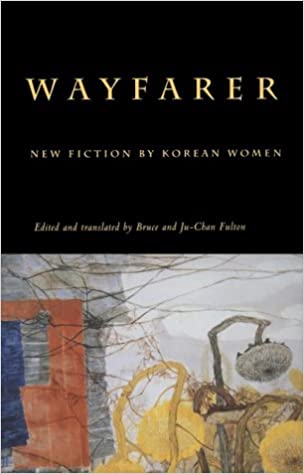
Wayfarer: New Fiction by Korean Women
Edited and Translated by Bruce and Ju-Chen Fulton
(1997)
Women in Translation
(Short Story Anthology)
Published in 1997, this collection features eight short stories. The editors, Bruce and Ju-chen Fulton, include five of these texts in their collection, The Future of Silence: Fiction by Korean Women, published in 2018.
“Almaden,” by Kim Chi-won. Please see the entry for “Almaden” in The Future of Silence: Fiction by Korean Women, published in 2018.
“The Last of Hanak’o” (1994)
By Ch’oe Yun
Ch’oe Yun is also the author of the short story collection, There a Petal Silently Falls. Ch’oe’s narrator is a middle-aged man who finds himself alone on a business trip to Venice. He reveals his dissatisfaction with traveling alone, general anxiety about the course his life has taken, and the emptiness of his marriage. He reflects on his annual meetings with his college buddies and returns in his memory to when they were in school and ready to let go on a night of communal drinking. He relates that two women were often a part of the group, a petite, frank young woman and what may have been her only friend, someone he refers to as her “shadow.” The narrator then reveals that before leaving for Italy he discovered that this young woman the man call “Hanak’o” –the Nose–is working not far from Venice and, using great discretion and persistence, succeeded in tracking down her phone number. Will the narrator make the call, and what is his goal in reconnecting with this enigmatic woman who exerted and continues to exert some strange hold on this group of men? This is an absolutely delightful read; Ch’oe is a master of holding back truths. Her male characters ring true as they struggle with their memories of their past and their complex relationship with the enigmatic Hanak’o. The story is also of value to those interested in LGBTQ themes and bullying.
“That she was now called Hanak’o was the result of a mistake they all wanted to hide. A small mistake that hid many truths, that had srisen in drunkenness, that no one wanted to admit or retrace thoroughly. We all have a secret person we can’t deal with comfortably without a nickname, and for them that person was Hanak’o.” (15)
“Human Decency” (1993)
By Kong Chi-yong
Kong’s narrator is a writer in her thirties who works for a traditional women’s magazine. Her editor manages to score an opportunity for her to interview an A-list celebrity in the art world: Yi Min-ja, who burst onto the Korean art scene at twenty-one, went off to achieve even greater success in Europe, moved to India, began following a guru and returned to Korea in order to write a wildly popular book on her life and the benefits of meditation. As much as the narrator is influenced and inspired by the words, conduct, and achievements of Ms. Yi, she can not stop thinking about the incomplete article that she needed to set aside in order to get this scoop: her interview with Kwon O-gyu, who was just released from prison after serving twenty years for his political crimes during the rule of Park Chung-hee. In truth, her interview with Kwon O-gyu was not particularly productive. Like Yi Min-ja, he has written a book about his experiences, but it is not selling well and he proves to be a quiet, recalcitrant interviewee. Yet her time with this survivor forces the narrator to consider her own role in the student movements for democracy. Ultimately, she walked away from the group she was a part of and began living a life outside of the shadows and the constant fear of arrest, but like Kwon O-gyu, she personally knows too many young men who died for the cause, men whose faces she can still see. Kong’s short story would be an excellent choice to reveal the human cost of democracy movements in Korea during the 70s, 80s, and 90s.
“But as he looked at the card that identified me as a writer for the Women’s Monthly, the strange feeling returned. What could the Women’s Monthly possibly mean to a man who had spent twenty years in prison, a man who had forgotten how to open a door from the inside? Had he ever read it? Would he read such a magazine in the future?” (57)
“Scarlet Fingernails”
By Kim Mun-suk
Kim relates a beautifully restrained story about a complicated reunion between a father and his daughter. The narrator is a mother of two who lives with her mother. As far as she knows, the father she has never seen was abducted by North Korean forces at the end of the Korean War. As a child, she conflated her experiences of watching nationalistic South Korean films with fantasies about the heroism of her father. Yet when she learns the great family secret about where and why her father is imprisoned, her world turns upside down. She sympathizes for the first time with the hardness her mother has adopted toward her father even while she wonders why her mother never remarried. When the parents of her father petition the government to visit them before they die, they invite the narrator, her husband, their two children, and her mother, to join them in celebrating the man’s life; after all, he is now sixty-one years old and prison has left him in poor health. The meeting with her father triggers revelations of many long-held secrets, many justifying the simmering resentment toward the old man held by his relatives and descendants. The story raises fascinating questions not only about familial love, but also about the ways South Korea sought justice, punishment, and security after the war.
“When I was little I used to go to bed early and sometimes I’d be awakened by my mother applying balsam color on my little fingernails. Her face, flushed and perspiring, rapt with attention, was so lovely. I used to thrash around in my sleep, and the next morning some of the leaf wrappers were always missing, leaving the scarlet color of my nails uneven. I would compare my nails with Mother’s and whine that mine weren’t as beautiful.” (83)
“Dear Distant Love,” by So Yong-un. Please see the entry for “Dear Distant Love” in The Future of Silence: Fiction by Korean Women, published in 2018.
“Identical Apartments” by Pak Wan-so. Please see the entry for “Identical Apartments” in The Future of Silence: Fiction by Korean Women, published in 2018.
“The Flowering of Our Lives,” by Kong Son-ok. Please see the entry for “The Flowering of Our Lives” in The Future of Silence: Fiction by Korean Women, published in 2018.
“Wayfarer,” by Chong-hui. Please see the entry for “Wayfarer” in The Future of Silence: Fiction by Korean Women, published in 2018.
 East Asian Literature in Translation