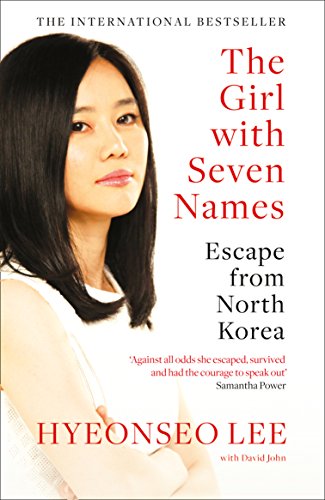
The Girl With Seven Names: A North Korean Defector’s Story, by Lee Hyeon-seo with David John (2015)
William Collins
Memoir
Lee Hyeon-seo’s account of growing up in North Korea, her escape, her ten-year experience living as an undocumented person in China, and her eventual escape to South Korea makes for fast-paced, informative, and compelling reading. One of her greatest strokes of good fortune is that she was born and raised in a town on the Yalu River, the geographical border which divides North Korea from China. Another unexpected boon was her father’s insistence that she study The Thousand Character Classic; thus she grew up being able to read and write in Chinese. Her early struggles with the language are more than rewarded when her ability to write in Mandarin allows her to pass as Chinese. Finally, there is her mother, a larger-than-life scrapper and schemer who is forever maneuvering to position the family to achieve success in the bustling smuggling trade that runs between China and North Korea. The river is crossable in many places, and if one has the wherewithal to bribe the guards on either side of the river, it is possible to smuggle people, US dollars, food, illegal drugs, cell phones, household appliances, tools, etcetera. Lee’s description of the smuggling is both hair-raising and hilariously brazen. For example, she learns that her brother is making good money smuggling motorbike parts across the Yalu and assembling and selling them to North Koreans. Lee describes a network of relatives in China who helped her get to a major city and find employment. She lived in China for ten years. She tried several times to get to South Korea by using “brokers” who promised success and charged fortunes for their sketchy services before she envisioned a bold work-around: she booked a flight from China to South Korea via Thailand–a preposterous flight, and was promptly arrested on arriving in South Korea. She describes the process by which she was acclimated to South Korean society, her work experience there, as well as her remarkable efforts to return to China to help her mother escape. This is a fascinating and moving tale that reveals much about life in the two Koreas and China as well.
“My mother was a born entrepreneur. This aspect of her was unusual for a woman of high songbun. Many such women during the 1980s and early 1990s would have regarded making money from trade as immoral and beneath their dignity. But my mother was from Hyesan, and had a nose for a deal. Over the years ahead she would run many small, profitable ventures that would keep the family alive through the worst imaginable times. ‘Trade’ and ‘market’ were still dirty words when I was growing up, but within a few years attitudes would change radically, when it became a matter of survival.”
 East Asian Literature in Translation