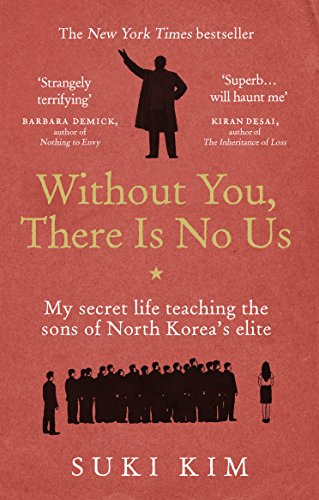
Without You, There is No Us: Undercover Among the Sons of North Korea’s Elite, by Suki Kim
(2015)
Crown
(Memoir, Social Commentary)
Ms. Kim is Korean American. Both her parents came from families separated by the partition of Korea. When she learns of an opportunity to join a group of Evangelical Christian educators invited to teach English at the Pyongyang University of Science and Technology, she volunteers to join them. Ms. Kim conceals from her hosts two key truths: she is an atheist and a journalist. She works at the school during a crucial period in North Korean history: the last six months of Kim Jong-Il’s reign. She reports on the privileged yet limited world of her students, the sons of North Korea’s top military and political leaders. Inside the walled compound of the university, Ms. Kim is able to capture the proud nationalism of her students as well as their anxiety that all might not be as it seems. She also writes about her own predicament: though she criticizes the misinformation of the party and tries to get beyond the pro-Party face her students wear in public, she is lying to her colleagues about her faith and hiding her reporting from the intensive surveillance of her North Korean supervisors.
Ms. Kim’s combination of reporting and memoir might be interesting to combine with Orwell’s 1984 or Huxley’s Brave New World, as students often regard these dystopian portrayals of surveillance states as purely the stuff of fantasy. Ms. Kim shows how the North Korean political machine sabotages the human need to build trust and share honest emotions.
“Was it fate that my North Korean experience began with [Kim Jong-il’s] birthday and ended with his death? It was February 2002 when I first glimpsed the forbidden city of Pyongyang as part of a Korean-American delegation visiting for Kim Jong-il’s sixtieth birthday celebrations. It was only a few months after 9/11, and George W. Bush had just christened that country part of an ‘axis of evil,”’so it was an inauspicious time for a single American woman to cross its border with a group of strangers.” (80 “The Anti-Atlantis”)
 East Asian Literature in Translation