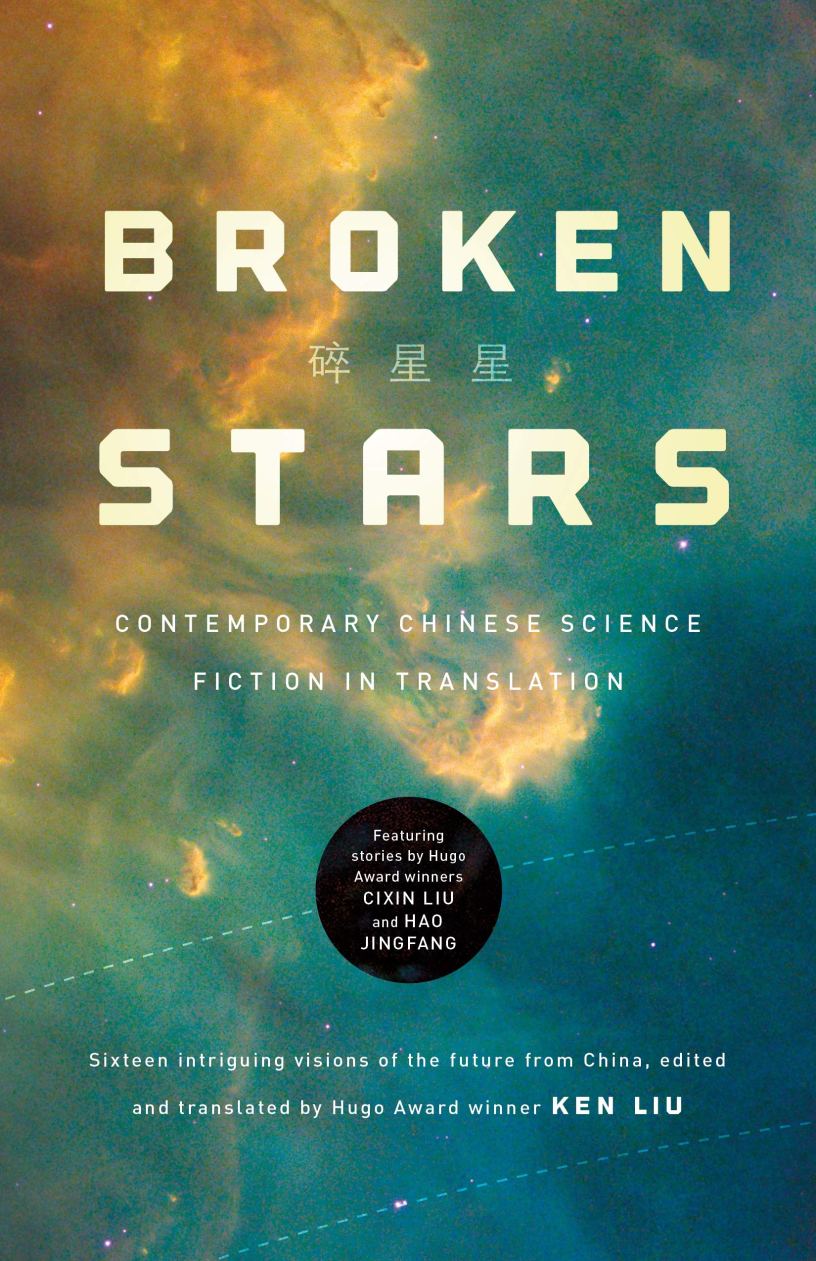
Broken Stars, edited by Ken Liu
Translated by Ken Liu et al.
(2019)
Tor Books
(Science Fiction Short Story Collection)
This is Ken Liu’s second collection of Chinese science fiction in translation. The first Invisible Planets, published in 2016, opened the door. This new collection features more fiction by women as well as three provocative essays on the art and purpose of science fiction in the 21st century:“A Brief Introduction to Chinese Science Fiction and Fandom” by Regina Kanyu Wang; “A New Continent for China Scholars: Chinese Science Fiction Studies” by Mingwei Song, and “Science Fiction: Embarrassing No More” by Fei Dao.
“Goodnight, Melancholy”
By Xia Jia (f.)
Xia Jia’s narrator is an artist and programmer working in the near future who is working with artificial intelligence. That scientist is reflecting on and imagining the life and work of Alan Turing, the Imitation Game or “Turing Test” he proposed for determining whether artificial intelligence could pass as human, his relationships with his lovers, and the coded strips of paper found in his belongings at the time of his death. Xia Jia blends fact and fiction in her work with Turing (so successfully that she seems to have taken in an expert in his biography) in order to get at the complexities of the man while trying to make a case for the unmeasurable human element in thinking, reason, and discovery. This story may also be interesting to those wanting to discuss LGBTQ themes.
“The records showed that Turing treated Christopher as another person. He spoke to Christopher of recollections from childhood; of his nightly dreams—and his attempts at analyzing his own psychological state through these dreams; of the latest advances in scientific research; of literature, including George Bernard Shaw’s Back to Methuselah and Leo Tolstoy’s War and Peace; of secrets that he did not share with anyone else, such as his romantic memories of different lovers …” (30)
“Moonlight”
By Liu Cixin (m.)
The author of the internationally renowned Three Body Problem, Liu Cixin, presents us with three phone calls. Each one comes from a distant future. As the narrator discovers, the caller is none other than his future self. With each call, the voice at the other end of the line rapidly sketches out the imminent doom of Shanghai and the planet. In each case, the cataclysm is the result of the burgeoning human population and humanity’s attempt to supply its population with energy. Liu Cixin, the master of “hard science fiction” uses the short story to lay out three bold and elegant solutions to our endless hunger for fuel. Each one brought to life in the simplest yet most vivid metaphors brings light to a frightening world. However, as inventive and resourceful as he is, he is compelled to reveal the unexpected consequences of each of his creations.
“Of course it doesn’t sound like the ocean. Even the Huangpu River is almost dried out. This is the drought season—there are only two seasons now, drought and flood. It’s possible to cross the river just by rolling up your pant legs. In fact, several hundred thousand starving refugees have just crossed the river into Pudong, covering the riverbed like a mass of ants.’” (73)
“Broken Stars”
By Tang Fei (f.)
(NSFW)
Tang Fei writes in a variety of genres. “Broken Stars” begins in the emotionally fraught world of high school, with a cute but angsty nerd girl is drawn to both a sexually powerful older girl and a bad boy who, when we first see him, is atop a fence in a lightning storm lighting a cigarette. It is very pedestrian stuff until the narrator goes to bed and dreams, again, of “the white lady,” a figure who has been appearing to her since her mother’s death. This mysterious stranger speaks in riddles, uses an astrolabe, and claims to be able to predict the future. The narrator increasingly doubts the prognostications of the white lady/mother figure and chafes at the options afforded her by the movement of the planets and stars. Eventually, she makes a violent stand: she will control her own fate by rewriting the course of the heavens.
“Tomorrow, there will be happiness. You’ll walk a path that you don’t normally walk, and make a date in the morning. The stars say that you’ll meet someone important, someone you’ll spend the rest of your life with. The date will change your destiny, so be careful of wrong turns. The stars are speaking. Listen, the stars are talking, all of them. Can you hear them? The stars want you to be happy.” (95)
“Submarines”
By Han Song (m.)
Introducing this author, Ken Liu writes “As a senior member of Xinhua, China’s state news agency, Han Song occupies a unique position as an observer and chronicler of the cataclysmic changes transforming China. There are things he can say that perhaps no other writer can say” (111). This very short story, like “Salinger and the Koreans,” is vivid, inventive, sly, and utterly convincing. The story is told through the wondering eyes of children who spend their days studying the marvelous creations of the peasants who provide the labor that supports Shanghai. Unlike the adult citizens of the megalopolis who stare without feeling at the activity on the river, the children let their imaginations run wild, dream of what may be hidden below the surface, and plot to make contact.
“Without any announcement, they had dived, as if the peasants couldn’t sleep soundly without the comfort of being covered by water, like water birds that had to tuck their heads beneath their wings to nap. Only by submerging their families and homes could they leave their worries behind on the surface, hold danger and uncertainty at bay, and dream sweet dreams without being bothered by the city-dwellers…” (116)
“Salinger and the Koreans”
By Han Song (m.)
A must-read for anyone who has ever taught year nine English in a private school! Han presents us with a brilliant take on ambiguity and literary criticism–among other things. In this world, North Korea takes over the United States not with brute force but with the invention of a “Quantum Reambiguator.” As it turns out, one of the primary goals of the hermit nation is to track down and elevate the hermit writer, J.D. Salinger, whom they revere as a Marx-like anti-capitalist demigod. Generations of North Koreans grew up reading The Catcher in the Rye as a critique of the emptiness of capitalism, and when they finally drive tanks through the author’s gated compound and approach his cabin door, they do so as acolytes approaching the feet of a Buddha. Han’s portrayal of the North Koreans and Salinger, as well as his send-up of the course of the relationship between the idolatrous nation, the author’s book, and the author himself is a gleefully wicked ride.
“The Koreans saw Salinger as a precursor to the full liberation of humanity. It was because of his book that the Koreans had vowed to liberate the entire human race in the first place. These gentle, unsophisticated, earthy people from Asia loved Salinger from the depths of their hearts.” (129)
“Under a Dangling Sky”
By Cheng Jingbo (f.)
Cheng Jingbo roots this natural-world fantasy in Western mythology about dolphins. She also makes use of traditional names for Western constellations and uses the English Jack and the Beanstalk tales as touchpoints in her story. The world she describes is alive with furious motion. Whirlpools and whirlwinds threaten, moved by fierce currents. But high above, the sky appears to be moving much more slowly. The protagonist is quite certain that the sky is a dark, barely translucent shell that encircles the globe. How then might it be possible to test that hypothesis?
“The mad child was going to climb up the beanstalk to the giant’s castle. But … if the crystal sky was truly an ice cover intended to keep us from the secrets of heaven, how could Giana reach the stars?” (146)
“What has Passed Shall in Kinder Light Appear”
By Baoshu (m.)
Li Jun, who writes under the pseudonym “Baoshu” completed his undergraduate and graduate studies in the Philosophy Department of Peking University. His first major effort in the science fiction genre was a work of internet-based fan fiction called “Three Body X: Aeon of Contemplation,” a response to Liu Cixin’s Three Body Problem trilogy. “What has Passed Shall in Kinder Light Appear” is a brilliant piece of invention and storytelling. At its core is the life story of a man who lives from the birth of the Chinese Republic to the 21st century. Anyone remotely familiar with this historical period knows that he and his family will suffer waves of upheaval, violence, suffering, and loss. Baoshu’s protagonist encounters it all and suffers time’s sling and arrows with convincing and affecting persistence. What sets the work apart is the author’s time structure: the hero is born on the day of the Tiananmen Square Massacre in 1989, and from there, he and his loved ones experience recent Chinese history. He sees the Chinese Olympics in 2008 and suffers the collapse of the global economy, at which point he begins to relive Chinese history in reverse order, a bit like Forrest Gump, he finds himself on the anvil of historical time as catastrophe after catastrophe befalls him, until finally he faces his last days in the legendary caves at Yan’an, not far from the shadow of Mao Zedong. Baoshu tells a brilliant and heartbreaking story, complex yet human, which bears up well under multiple readings. At 72 pages, it is one of the longest pieces in this collection.
“I thought I had been through too much ever to be moved by the shifting vicissitudes of fortune. But I was wrong. In that moment, my eyes grew blurry. Tiananmen became an old watercolor painting, dissolving in my hot tears. One time, the entire country celebrated the founding of the People’s Republic with a parade through this very square; one time, students from around the country gathered here to demand democracy; one time, Chairman Mao stood here and surveyed the Red Guards—where were they now? Had it all been a dream?” (212)
“The New Year Train”
By Hao Jingfang (f.)
Hao Jingfang studied Physics as an undergraduate at Tsinghua and Astrophysics in graduate school. She then earned a degree in Economics. She is a successful novelist who also writes science fiction. At only five pages, “The New Year Train” is an example of short-short fiction. The piece is set up as a dialogue between a television reporter and the CEO/Chief Scientific Officer of a new technology that will end China’s reliance on high-speed rail. The director has found a way to use black holes to take shortcuts through time and distance, a service he believes will be of great use in facilitating the travel of Chinese citizens during the Lunar New Year celebration, the world’s largest annual migration of human beings. Unfortunately, the train has disappeared. No one can find it or the thousands of people on board.
Reporter:… “I think it’s best we stop talking about theories. Let me ask you a different question: prior to this accident, Homeward Bound was not licensed by the relevant authorities. You were selling tickets illegally, weren’t you?”
Li: “The transportation market is dominated by inefficient monopolies. We had no choice but to push the regulatory framework to Uberize space-time to better serve the people.” (229)
“The Robot Who Liked to Tell Tall-Tales”
By Fei Dao (m.)
Though he initially planned to study Environmental Engineering at Beijing Normal University, Fei wound up choosing to major in Science Fiction, the only major like it in all of China. This piece features elements of both fantasy and science fiction, with a fair bit of social commentary and humor for spice. A just and perfect king has created a perfect kingdom. His only failure is a son who tells lies all day to anyone who will listen, earning him the title of “the Prince of Bullshit.” Unable to modify his son’s behavior, he hits upon a solution: reasoning that everyone will forget his son’s habit if someone outstrips in the act of lying, he orders a robot to travel the land fabricating and “fictioneering.” Sure enough, the robot masters the art of fiction, regaling all with terrific “whoppers.” Eventually, he comes across three men in a bar who are the past masters of delusion and distraction, men who have used their skills again and again to escape the greatest audience of all: death.
“In the race against Death, I think speed trumps everything else. All discussions about a soulful exchange between the writer and the reader are mere nonsense. The only goal for my writing is keeping up the pace.” The pipe-smoking author took out a thick, beautifully bound hardcover book. “This object is as hard and strong as marble. I use it and other volumes like it to construct a staircase to heaven. As I finish each book, I lay it at the top, and another step is added. I build as I climb, and Death is always right behind me.” (241)
“The Snow of Jinyang”
By Zhang Ran (m.)
Trained in Computer Science, Zhang worked in IT, then as a journalist, and finally achieved significant success as an internet-based news commentator. “The Snow of Jinyang“ takes us into China’s far distant past to the age of the Song Dynasty (927-976). We are in the middle of the Northern Han fortress of Jinyang which is suffering its third or fourth year under siege. Three armies are outside the gates, and within, several powerful factions are attempting to convince the king either to surrender, create an alliance, or fight to the death. As the tension inside reaches a feverish point, strange developments are taking place in the city. Self-propelled vehicles begin motoring through the streets, catapults begin to launch explosive devices to devastating effect, and supply cars ride at high speed on rails built atop the city walls. The inventions might save the citizens, but many are alarmed by the man they call “fake Prince Lu,” who has set up a secretive factory at the East City Institute. The mysterious Lu is rarely seen, and he appears to be most at ease when working alongside the laborers he recruits from the prison adjacent to the institute. Readers familiar with Mark Twain’s A Connecticut Yankee in King Arthur’s Court will recognize the time travel tropes that serve as the backbone for this highly entertaining romp.
“The emperor was afraid of the Han soldiers deserting, so he had their faces tattooed with the name of their army divisions. The Jianxiong soldiers were tattooed ‘Jianxiong’; the Shouyang soldiers were tattooed ‘Shouyang.’ As for Liu Fourteenth, a homeless wanderer who’d been enlisting in every army he could find since boyhood, his face was inked shiny black from forehead to chin with the characters of every army that had ever patrolled this land.” (278)
“The Restaurant at the End of the Universe: Laba Porridge”
By Anna Wu (f.)
Translated by Carmen Yiling Yan and Ken Liu
Wu is an author and screenwriter. She also blogs about cooking, and in this short story she builds her story around a cooking metaphor, or rather, the origin story of the standard dish, “sweet Laba porridge.” Like many recipes from around the world, the core version of the meal arose from a blend of poverty, desperation, and invention. Wu sets her scene in a restaurant at the end of the universe, a nod to the late Douglas Adams, and the major characters are the owner/chef, a waitress who may or may not be his daughter, and a solitary guest sitting alone at a table for two. The rules of the restaurant are that a guest may tell the chef a story; if it is sufficiently stimulating, the chef will offer his best meal “on the house.” Yet this time, when the waitress asks if the chef will make the offer to the guest, he instead tells his own tale, about a writer named Ah-Chen, a client of the Agency of Mysteries. As the chef relates a cautionary tale about Ah-Chen’s scientific, quasi-magical, and Faustian efforts to master the craft of writing, the daughter begins to wonder whose story her father is telling.
“A month later, the Agency of Mysteries brought B’s ability. Ah Chen’s ears became peculiarly sensitive to sounds; they left indelible marks in his mind. When he heard wind, music, thunder, or even the barking of dogs, every syllable seemed imbued with new significance. Poems, essays, haikus, and colorful slang rose from the pages as if given life, linking their hands and dancing, endlessly dancing, passing before his eyes one after the other like little fairies.” (336)
“The Emperor’s First Games”
By Ma Boyoyng (m.)
Ma blogs, writes, lectures, and blogs. In his writing, he combines elements of fantasy, science fiction, wuxia tropes, and an encyclopedic knowledge of Chinese history. In this piece, Ma takes us to the time of China’s first emperor, Qin Shihuang. Emperor Qin, weary from the struggle to unite his kingdom and bring about a period of peace, desires only entertainment and summons his advisors. The advisors see this as an opportunity. Each is keen to educate the Emperor in specific Chinese values so that the peace will hold and the kingdom will thrive. Confucians, Mohists, generals, agriculturalists, the School of Names, and the School of Yin and Yang wish to mold their leader. Realizing that their master is impatient when it comes to studying, they hit upon a clever solution: each provides the Emperor with a game that should theoretically foster the growth of wisdom in the player. Moreover, the learning of the Emperor should be accelerated as he will be the only player and the games are to be played on the imperial computer. And so we witness Qin Shihuang as his ego and intellect attempt to “win” classic computer games such as Civilization, The Sims, Zombie Tower Defense, Call of Duty, Harvest Moon, and Sword and Fairy.
“‘Your Imperial Majesty, first, you must create a character, and then guide him through a simulated world. There, he must follow the rituals and enact the rites of Confucianism to give his life meaning. For example, you must visit your neighbors often to increase their friendliness toward you. As the Great Sage himself said, ‘Broaden the respect you have for your own aged parents to the parents of others; expand the love you have for your own children to the children of others. The heart of this game is the strengthening of social ties.…’ The lecture bored the emperor.”(349)
“Reflection”
By Gu Shi (f.)
Gu is an urban planner by trade, but she writes and publishes in a wide variety of science-fiction and fantasy magazines. In “Reflection” her characters play a complex game involving an enigmatic female clairvoyant, Mark, a newspaper editor who has been following her unbroken string of successful predictions, and a diffident reporter named Ed Lin who was trained as a scientist. His interviews with the clairvoyant, a fourteen-year-old girl when he first meets her, are uncanny. Sometimes she recognizes him, sometimes not. They carry on a relationship over many years, and although she continues to reveal the future with alarming accuracy, Ed fails to learn anything concrete about her at all. He even develops feelings for the woman, though they are not meant to be. In the end, Gu reveals all in a coup de foudre: none of the characters are who they claim to be.
“Yes, a girl, maybe fourteen years of age. Her hands and feet were thinner and more elongated compared to an adult’s. She was dressed in a black leotard and a pair of black tights, and her pale neck rose like a stalk, topped by a round, childish face. But contrary to her general appearance, her gaze was sharp and tolerant, like an old woman’s.” (359)
“The Brain Box”
By Regina Kanyu Wang (f.)
Wang is an award-winning science fiction writer with a strong following. This short piece alludes to the Heisenberg Uncertainty Principle and there seem to be echoes of John Berger’s About Looking. The story is about a woman who is one of the many first adopters of a new technology marketed as “The Brain Box.” The device is implanted in the user’s brain. It is undetectable to the eye and the only person who will ever know it is there and functioning is the user. Its purpose is similar to the “Black Box” in an aircraft. It runs all the time, recording thoughts and overwriting thoughts until the user passes away, at which time the device may be removed by medical personnel and delivered to the surviving family, who, if they present the device to the technicians at Brain Box, will be able to replay the final five minutes of thoughts of the deceased.
“I’m sorry, Mr. Fang, but please wait until I’ve finished reading the whole statement before answering ‘Yes, I consent’ or ‘No, I do not.’ The protocol requires it be done this way. Now, where were we … oh, right—that we cannot ascertain the full range of potential effects of imprinting into another brain the brain patterns of a person on the verge of death; that possible effects could include, but are not limited to, damage to the target brain, disorientation due to conflicting mental patterns, rejection of imprinted thoughts by the target brain.…” (377)
“Coming of the Light”
By Chen Qiufang (m.)
If you come to the world of marketing and phone apps with an alert and wary mind, read on. The protagonist is a marketer whose client has developed a new watermarking app. Any picture taken with the app is automatically watermarked. Any unauthorized attempt to alter, monetize, or reuse that image can be detected by the user, even if only a fragment of the original picture is used. With this app, users could be certain that their images are not being used without their permission. Higher-ups decide that the market might not be willing to adopt the app right away. Perhaps they could gin-up interest by marketing it as entertainment? They produce Truthgram, an app where users can point to any picture in order to reveal the original photo. In the opening days, the app sells like hotcakes, but it runs into trouble with the selfie crowd that processes their photos with multiple filters. When this idea tanks, they hit upon another approach to security: what if there was an app that was blessed by a bodhisattva? Would such an app confer a protective blessing on the user each time they used it?
“Mr. Wan is our god, the CEO of an Internet company. Out of any ten random people who accost strangers in the streets of Zhongguancun—’China’s Silicon Valley’—one would be engaged in ‘network marketing,’ two would be trying to hook you on pyramid schemes, three would be trying to talk to you about Jesus, and the rest would all be founders or C-whatever-Os of some startup.” (389)
“The History of Future Illnesses”
By Chen Qiufang (m.)
Chen brings his skeptical eye to the internet once again with “The History of Future Illnesses.” No doubt aware of the psychological and physical maladies already affecting this generation of technology users who are constantly gazing at iphones, iwatches, ipads, computers, smart devices, etc, Chen projects himself into the future to catalogue the impact of being always online on the human body and psyche. He look s at the extent that we are overstimulated, or how looking at heavily filtered images of ordinary people and superstar will fuel a desperate race to modify our appearance through addiction to surgical or chemical modification, or how the way we tend to adopt other personalities than our own when playing games or participating in discussions on multiple sites might cause a fracturing of our self identity.
“The academic consensus was that this special type of perceptual dysfunction occurred because babies were exposed to the intense visual and tactile feedback of the iPad before their sensory neural connections were fully developed. Aimless hand movements led to an overabundance of concentrated visual and tactile sensory information, which had to be adequately integrated and coordinated with the rest of the body to form a solid foundation for the development of bodily self-image. This was precisely the key step missing in the development of those afflicted with iPad syndrome. To them, the regular world was dim, blurry, low-resolution, unresponsive to the sliding finger and utterly devoid of wonder.” (418)
 East Asian Literature in Translation