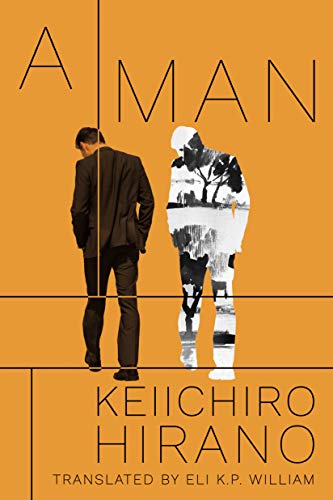
A Man
By Hirano Keiichiro
Translated by Eli K.P. William
(2018, translated 2020)
Amazon Publishing
(Novel)
In A Man, Hirano presents the search for the true identity of a man who became a johatsu, one of the thousands of contemporary Japanese citizens who, trapped in lives that are tainted by shame, “evaporate” themselves by disappearing and appearing somewhere else under adopted identities. As in many modern novels, there is a framing device in A Man: the narrator is an author who claims that he was introduced to the story by a middle-aged lawyer, a man he calls Kido-San, who became obsessed with determining the identity of a client’s deceased husband. His client, the widow Rie, comes from an isolated rural area. She lost her first husband and one of her sons to illness. She remarried though, to a man who joined the community in his forties and took up work as a forester. The couple was truly happy. They had a child together, a daughter, and this fellow, Daisuke, was a loving father both to his daughter and stepson. Tragically, Daisuke was killed in an accident at work. Although Daisuke insisted that he would never want to reconnect with his estranged family, Rie feels compelled to let his parents know of their son’s tragic death. However, when Daisuke’s abusive, braggart brother appears at the funeral, he insists that the man in Rie’s photographs is not his good-for-nothing sibling. Kido-San takes up the complex case, one that complicates the lives of everyone who knew the deceased. His wife is desperate to know the true identity of the man she married and will not bury him in the family plot until she knows who he is. When she expresses her wish to legally readopt her maiden name, her son objects. Though only in his early teens, he will then have changed his name three times. He is already bullied at school. How can his mother be so selfish? Meanwhile, the headstrong older brother is convinced that the impostor who took on the name of Daisuke must have murdered his brother—a crime that must be avenged. The lawyer Kido-San takes up the case and soon becomes obsessed with learning about the people who wish to “evaporate” and the underground trade in identity. He meets a brilliant and deeply disturbing prisoner who may have sold the “Daisuke” identity to the dead man, only to discover that those who change their identities often change them again. The complex stories that Kido-San uncovers as well as the beautiful person that “Daisuke” became are more than rewarding enough. However, A Man becomes truly great as a study in identity when we realize that Kido-San, married to a beautiful and successful businesswoman, well-to-do, and an engaged father, is also yearning to know who he might have become if he had not chosen to be a lawyer or married his wife or became a parent. His fantasies of starting over are symptomatic of the male mid-life crisis: it is no surprise that he finds himself falling a bit in love with the two women who loved the man known as Daisuke. At the heart of his identity dysphoria is something more elemental: Daisuke is a zainichi, a mixed-race Korean-Japanese. He constantly reassures himself and others that he is a third-generation zainichi and that he has full citizenship as a Japanese, but he has never quite felt comfortable in his skin – and investigating the world of the johatsu allows him to imagine reinventing himself as a more integrated and socially at ease self.
“Misfortune can visit itself upon anyone. But when it comes to serious misfortune, we have a tendency to presume that, if it happens at all, it can only happen once in a lifetime. The fortunate imagine this to be so out of a certain kind of naivety. Those who have actually experienced misfortune pray for it to be so as a desperate wish. And yet, the sort of major misfortune for which once is plenty, sadly, has something in common with the stray dog that persistently chases the same person around, twice and then thrice. It is in the midst of such recurrent misfortune that people visit shrines for purification ceremonies or have their names changed.” (10)
 East Asian Literature in Translation