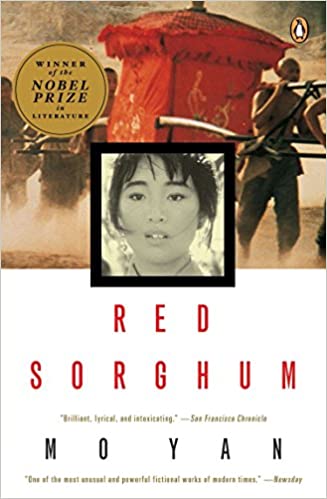
Red Sorghum: A Novel of China
By Mo Yan
Translated by Howard Goldblatt
1986, translated 1993
Penguin
(Novel)
Mo’s Red Sorghum is a masterpiece of storytelling. He relates the familial lore of three generations of the Shandong family. All of the action takes place in the Northeast Gaomi Township, a remote region where itinerant judges struggle to limit the raiding and infighting among multiple warring gangs of thieves. The principal crop of Gaomi is red sorghum, a cereal grain that is a staple food and the source of the potent wine distilled by the Shandong family. Yan’s stories cover a period beginning in 1926 and ending in 1973, but his narrative conceit is non-linear and follows a path that is recursive and at times extraordinarily challenging to follow. Yan initially composed the novel as a series of novellas and published them serially in a magazine. The novellas include “Red Sorghum,” “Sorghum Wine, “Dog Ways,” “Sorghum Funeral,” and “Strange Death.” The central story focuses on the Japanese invasion and the heroic battle fought at Black Water River in 1939 by Commander Yu, the grandfather of the teller of the tales. The stories are awash in violence and bloodshed, though Yan devotes particular vehemence and graphic detail to his description of the inhumanity displayed by the Japanese and Chinese “puppet soldiers,” including their massacre of civilians during the Mid-Autumn Festival of 1937, the gang rape of second-grandmother Passion and bayonetting of five-year-old Little Auntie, as well as the mutilation and skinning alive of Uncle Arhat. The heroes are not only blackguards and resistance fighters but also a string of powerful women, including grandmother Dai Fenglian or “Little Nine,” second grandmother “Passion,” and third grandmother “old woman Liu.” Yan blends mythology and local history; his style is a particularly spectacular form of magic realism. Fox spirits, bloody sorghum, and corpse-eating dogs appear throughout the novel with nightmarish regularity. Though the stories can be maddeningly difficult to follow, the overall effect is sublime, and Yan’s characters “Spotted Neck,” “Pocky Leng,” “Nine Dreams Tsai,” “Pocky Chung” and “Eighteen Stabs Geng” are unforgettable. Though the novel is revered in China, the final tale of “Eighteen Stabs Geng,” a survivor of a bayonetting by Japanese soldiers, dying of starvation outside the locked gates of a commune in the 1970s is a powerful criticism of Mao and the Cultural Revolution. Zhang Yimou tells a bare-bones version of the novel in his 1988 film Red Sorghum, which won a Golden Bear Award at the 1988 Berlin Film Festival.
“What is love? Everybody has his own answer. But this demon of an emotion has spelled doom for more valiant men and lovely, capable women than you can count. Based upon Granddad’s romantic history, my father’s tempestuous love affairs, and the pale desert of my own experiences, I’ve framed a pattern of love that applies to the three generations of my family. The first ingredient of love – fanaticism – is composed of heart-piercing suffering: the blood flows through the intestines and bowels, and out of the body as faeces the consistency of pitch. The second ingredient – cruelty – is composed of merciless criticism: each partner in the love affair wants to skin the other alive, physically and psychologically. They both want to rip out each other’s blood vessels, muscles, and every writhing internal organ, including the heart. The third ingredient – frigidity – is composed of a protracted heavy silence. Icy emotions frost the faces of people in love. Their teeth chatter so violently they can’t talk, no matter how badly they want to.”
 East Asian Literature in Translation