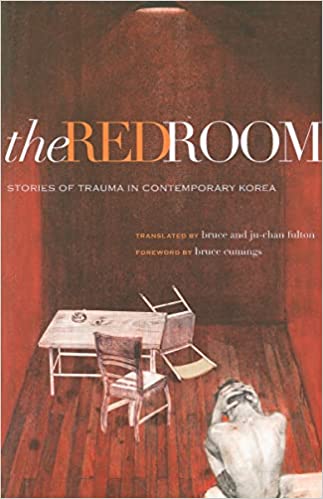
The Red Room: Stories of Trauma in Contemporary Korea
Translators: Bruce Fulton, Ju-Chan Fulton
Preface by Bruce Cummings
(2009)
University of Hawaii Press
(Short Story Collection)
All of the stories in this collection were written in the 20th century. Apart from “In the Realm of the Buddha,” which makes use of Pak Won-so’s sweet balm of wit, the stories require a strong heart.
“In the Realm of the Buddha, by Pak Won-so
Ms. Pak is one of Korea’s most accomplished and widely-respected authors. Twenty years after witnessing the deaths of her brother and father, a daughter joins her mother to pray for the souls of the departed at a series of temples, some Buddhist, and some animistic. The men had communist connections; the surviving family concealed these political affiliations as well as the manner of their deaths. Can the spirits of the dead find peace? And what about the living?
“There wasn’t a single person among my relatives and friends who considered the events of that time of upheaval significant—after all, that was some twenty years ago. They were more interested in whether Tobong or Yongdong was the better area for buying up land, in whether private lending or investment in stocks was more profitable. All they thought about was the means to a better life. That’s when their interest grew sharp, like an insect’s feelers.” (18)
“Spirit on the Wind,” by O Chong-Hui
Ms. O tells the story in four parts, employing male and female narrators. Shortly after marrying, a man’s wife begins exhibiting strange behavior, disappearing from her home for weeks at a time. The husband and his mother-in-law are beside themselves with fear for the missing woman, while also anxious that the young wife is being unfaithful. Even after she becomes a mother, the disappearances continue. Why does the woman wander? She may be driven by whatever happened during the civil war that left her an orphan, a memory she can’t quite recover.
“Could any desire be more ardent than this? Her despair had built to desperation, and now her only wish was to shield the boy from the eyes of others and never to release him unconditionally from her breast. Hadn’t she prayed, believed, when she gave birth to Song-il, that this tiny living thing would be her perfect anchor? But now, as the small boy across from her looped his noodles about his chopsticks, oblivious to her thoughts, Un-su’s face contorted in pain. He represented all the things she had lost, all the things she couldn’t do, and out of sight beneath the table she wrung her hands.” (105)
“The Red Room,” by Im Cho-Ru
Mr. Im is considered a subversive writer; many of his works are centered on the Gwangju Uprising, May 18-27, 1980. Demonstrations broke out in favor of an end to martial law and democratization. The military responded with violence. To this day, the uprising is contentious, as the government characterized the protesters as communists and suppressed all reporting of casualties. This harrowing short story is told through two narrators, a salaryman disillusioned with faith and marriage, sleepwalking through his life, and a member of the secret police, a Church deacon bitter about his nagging wife, his expensive children, and his mother who suffers from dementia and incontinence. The police officer abducts the salaryman for an unknown length of time, submitting him to humiliation and torture to get him to confess to providing temporary shelter to a college student suspected of subversion. As in much of Korean literature, Christianity is a central theme. Mr. Im’s characters each appropriate Christian tenets to support visions of society that are alternatingly noble, naïve, and sociopathic.
“It’s ridiculous—doesn’t make sense and you know it! The way you get equality and peace is through judgment and punishment. We all know that Jesus taught us to love our enemies, but he was referring to something completely different. He was teaching us to love our enemies who show repentance, remorse, penitence—he didn’t mean the offspring of Satan. And it’s you guys who are the offspring of Satan. Actually you are worse than that—you’re Satan himself. Dreaming of the socialist revolution. Communists, Reds, the wickedest people on Earth—you’re like poison mushrooms. We’ve got to root out those mushrooms and kill them, spores and all, make sure they never sprout again, wipe them all out, every last one.” (179)
 East Asian Literature in Translation