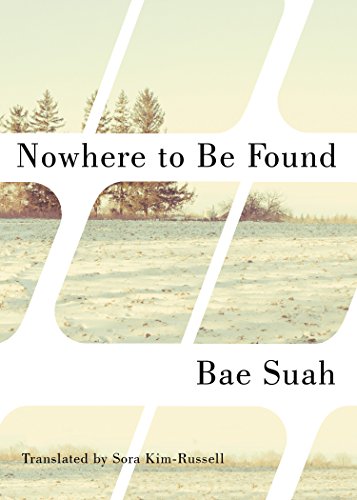
Nowhere to be Found
By Bae Suah
Translated by Sorah Kim-Russell
(1998, translated 2015)
Amazon Crossing
(Novella)
The novel is set in 1988, the year South Korea hosted the Olympics. The year before, over a million students participated in the June Democracy Protests, which led to the government’s presidential nominee Roh Tae Woo reinstituting direct presidential elections and civil rights. As hopeful as this moment was for the Korean people, Bae’s nineteen-year-old protagonist, her dysfunctional family, and her lovers are mired in paralysis and disillusionment. The late 80s in Korea was a time of great unemployment, and Bae certainly acknowledges that the economy bears a significant role in her family’s suffering. Her father has been sacked from his government job and imprisoned for corruption, and her mother is also out of work; she keeps a terrible psychological hold over her daughter, refusing to allow her true freedom until she repays her monetary debt to her parents. Her younger sister is in high school. In her analysis, there is no traditional path forward for her; she imagines dropping out of school and reinventing herself as a lesbian. Her older brother has spent years as a day laborer in construction; his dream is to go to Japan, find janitorial work, and send money home. But Bae’s world is suffering more than an economic depression. This is a loveless place where the family and social values have been stripped of any last vestige of love or care. The protagonist drifts through her empty life, sustaining her family by temping at a university and working as a waitress. An adjunct faculty member who teaches the forensics of murder makes repeated passes at her, but she can barely respond to his overtures. Her “love interest” is Cheolsu, a boy with whom she has disinterested, mechanical sex. The most dynamic and interesting element in the story is her epic journey: she takes a bus mid-winter to an army base in Yeongcheon to visit Cheolsu, who is completing his compulsory military service. The couple merely goes through the motions of being in a relationship which climaxes when she throws the chicken she has carried to Cheolsu from his mother into a frozen latrine. The book appears to have an epilogue: ten years after all this happened she returns to her home with another man, the adjunct faculty member. Looking at the condemned building, we might hope that the narrator is in a better place, but Bae doubles down on her nihilistic vision, forcing her character to suffer new levels of spiritual and physical humiliation. The novel can be a challenging read; Bae’s writing so perfectly captures the malaise of the time and the narrator that the language appears to drift, arrive at vaguely familiar cul de sacs, doubling back, and then come to a full stop, unsure of whether to hang fire or restart the path of wandering
”The rain falls, lays siege to the world, as if it has been falling that way for years. The rain will fall even after the death of time. Roof half falling down. Windows broken. Kitchen dripping rainwater. Porch covered in filth. Creaky stairs covered in cats’ paw prints. Dead rag doll, straw insides poking out. And, above all the gruesome things, our frigid relationship.” (40)
 East Asian Literature in Translation