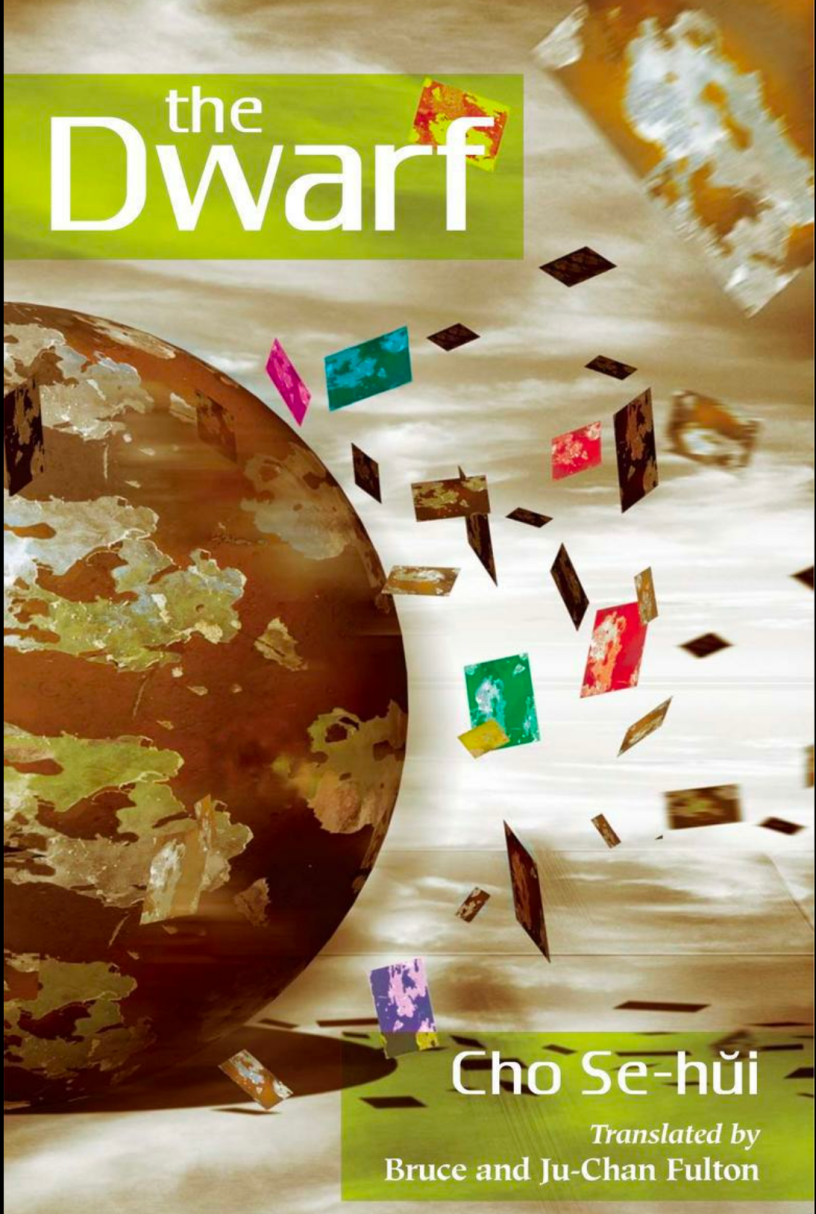
The Dwarf
By Cho Se-hui
Translated by Bruce and Ju-chan Fulton
(1978, Translated 2006)
University of Hawaii Press, Modern Korean Fiction
(Linked Story Novel)
The Dwarf was originally published as a series of linked short stories in various magazines. Eventually, they were collected into one volume and published as A Dwarf Launches a Little Ball. Written between 1975 and 1978, the stories all focus on the impact of the reconstruction of Seoul and the Korean economy on the poorest and least influential of the city’s inhabitants. The stories particularly decry the mandates of Park Chung-Hee, who instituted major economic reforms and began a policy of reconstruction that lead to the economic “Miracle on the Han.” Park stripped the rights of workers and gave new powers to factory owners. He also ordered the evacuation of temporary illegal housing that had served as homes for refugees of the Korean War. From Cho’s point of view, Park’s rule drove a knife into the soul of Korea, leaving it “a nation without a soul.” The dwarf is Mr. Kim Pul-i; his parents gave him that auspicious name hoping that he might someday rise above his social caste, but he is descended from a long line of slaves, and as we see in tale after tale, he and his family of lateral and figurative “little guys” are doomed to suffer for all time. Mr. Kim is three feet, ten inches tall. He has worked a number of jobs in his life, and he is currently putting food on the table by installing illegal taps in public water lines so that people living in the shanty town in the Felicity District of Eden Province can access potable water – of vital importance, as their homes abut an open sewer. When they receive notice that their home is to be demolished, the various family members go into action. Mrs. Kim weighs the different rates of compensation for the home and guards the scarred tin plate that identifies their home as their property. Mr. Kim confides in the local union leader, a wise but powerless leader; as a backup plan, the dwarf plots with an old friend, a hunchback, to market themselves for ready cash as a freak show. A brother takes up arms against the head of the powerful industrial group behind the movement to appropriate the land on which the shantytown stands, and Mr. Kim’s daughter becomes a mistress to a political power broker in the hopes of stemming or redirecting the heartless onslaught of modernization. Cho presents tales out of chronological order and shifts the narrator to different members of Mr. Kim’s family and peripheral characters, a strategy that mimics the calamities which befall the family. He also frames the tales between two interesting lectures, one on the Moebius Strip and the other on the Klein Bottle. The first and last introduce the idea that the tragedies suffered by the poor are cyclical and without end. However, it is the first lecture that cuts the deepest, as the teacher announces that although the students have passed their exams and are graduating, Korea has stopped using school to foster true learning and knowledge. He sends his students into the future assuring them that – as their leaders wish – they are fit only for consuming and producing capital.
“Except for the skills we acquired, there was nothing here in the way of a foothold for growing up. Our understanding was limited to what we were familiar with. None of us wanted to lose the foothold he’d sweated for. The company people didn’t want us to think. Workers worked, and that was it. The great majority of the workers accepted a situation in which change was impossible. And there was no one to awaken them to a single thing. Nor did the adults among us have any experience to pass on. All they saw was that reality moved in the direction opposite of what their hearts thought was right.”
 East Asian Literature in Translation