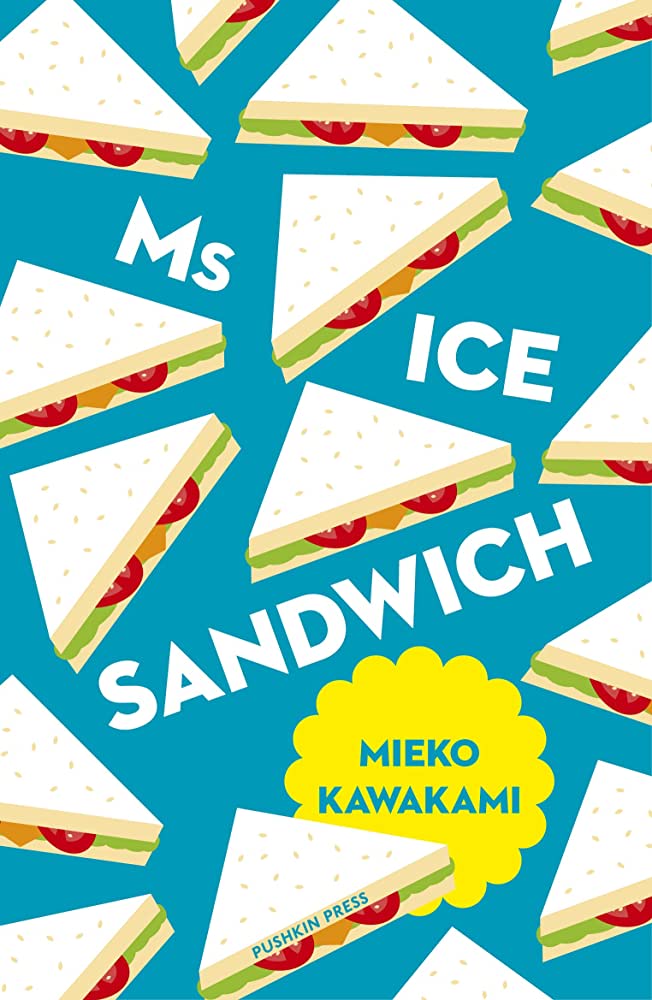
Ms. Ice Sandwich
by Mieko Kawakami
(2013, translated 2018)
Pushkin Press
(novella)
Ms. Ice Sandwich is a fast-paced and charming coming-of-age story told from the perspective of an odd fourth-grade boy. The young narrator has developed a bit of an obsession with the woman who works behind the sandwich counter at the local grocery store. His longing for love is not surprising: his father passed away when he was four; he has no memory of him, and his mother is a cipher. The narrator spends a lot of time with his grandmother, who lives upstairs. Although she has had several strokes and is largely unresponsive, the narrator talks to her about Ms. Ice Sandwich and shares with her his drawings of the large-eyed server. Meanwhile, his always-preoccupied mother has pilfered money from her mother-in-law without her knowledge to build an extension on the house, an ostentatiously western style add-on that his mother refers to as her “salon.” She meets nightly with troubled women; she may be running a business as a spiritualist or fortune teller. Her only other interest is her cellphone and computer; to her, the narrator might as well not exist. The narrator is also in his first relationship with a fellow fourth grader, a girl nicknamed Tutti. She lives with her divorced father, with whom she shares a passion for the films of Al Pacino. This offbeat story is well-written, wholesome, and provides a logical but nevertheless deeply satisfying resolution.
“All the time when I’m walking, eating lunch at school, staring at the toes of my shoes, anywhere I go, I’ve been wondering why I stopped going to see Ms. Ice Sandwich. And in my usual way, I’ve tried to write it down. What I’ve managed to figure out is it’s partly because of that day in the classroom when I overheard those girls talking about her. After that whenever I thought about going to the supermarket and seeing Ms. Ice Sandwich’s face, it’s not that I was afraid exactly, and I don’t really know why, but the feeling of happiness that I used to feel when I saw her, I kind of know that I won’t feel it again.” (47-48)
 East Asian Literature in Translation