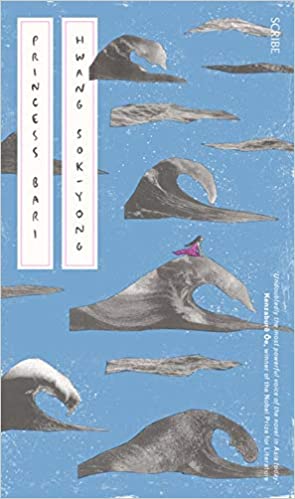
Princess Bari
By Hwang Sok-yong (m.)
Translated by Sora Kim-Russell
(2005, translated 2017)
Scribe US
(Novel)
In his novel Familiar Things, Hwang drew on Korean folklore to add a sense of hope and mystery to his tale of urban misery about children working as trash pickers. He revealed that dokkaebi, ancient nature gremlins, are continuing to thrive at the edges of Seoul’s toxic landfills and that there is hope that there will be a positive shift in the coming generations’ attitude toward the environment of Seoul and the entire Korean peninsula. In Princess Bari, Hwang again mines Korean folklore to bring us a tale of a young girl who escapes North Korea, flees to China, and then survives a deadly sea journey in a container ship to find some level of freedom and security as an illegal immigrant in London in the late 90s and early 2000s. The protagonist, Bari, is the seventh of seven girls born to an impoverished North Korean family. She is named after Barigongju, the abandoned Princess Bari. In the folktale, her parents are royal. They raise the six older daughters as princesses. When the King and King become ill, a shaman explains that their daughters must make a perilous journey to retrieve a healing potion. The princesses all refuse the dangerous task, but when poor Bari hears of the awful fate of her parents, she fulfills the quest and restores their health. Hwang describes Bari’s tale of survival vividly and realistically. At each step along the way, Bari is exploited and trafficked. This is no Disney fairy tale. Death by starvation, summary executions, and rape occur with sickening regularity. Though much of the tale is unique to the horrors of those who live in and escape North Korea, Bari eventually discovers that the world is not “free” in any way at all, as it is populated by seas of migrants fleeing violence and depredations from all over the world. There is also a great deal of love in the story as well–Bari finds support and community in unexpected places. Like her namesake, Bari is a quester. She encounters a variety of mentors, some of who visit her from the spirit world, and she discovers more people like her who are channeling cries for justice that are coming from the mouths of the exploited, the betrayed, the abandoned, and the dead. This is a powerful, dense story about the Korean diaspora and about the fate of a world that tolerates modern slavery if it is kept out of sight and keeps the costs of conveniences down.
“I was well aware that most North Koreans in my position weren’t paid for their work — they were grateful if they got so much as room and board. The police were not yet actively hunting down defectors, but they did show up if complaints were made. Regardless of the type of work they did, North Koreans earned no more than a third of what a documented Chinese resident might earn; but I was lucky, and earned half, and that was for doing mostly small errands as an apprentice.” (87)
 East Asian Literature in Translation