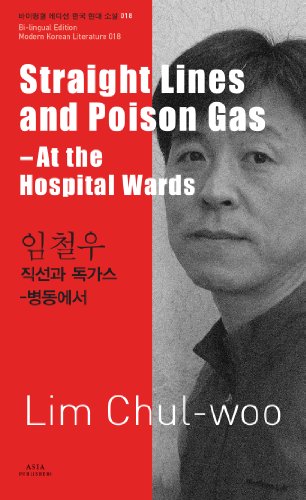
Straight Lines and Poison Gas, At the Hospital Wards
By Lim Chul-woo
Translated by
1981, translated 2013
ASIA Publishers Bilingual Edition Modern Korean Literature
Lim Chul-woo is an artist who has devoted his life to writing about the horrors of the 1980 Gwangju Massacre. Korea was in a state of great upheaval; the authoritarian Park Chung-hee was assassinated in May of 1979, and Chun Doo-hwan, the Chief of the Defense Security Command lead a successful military coup in December. On May 15th of 1980, some 100,000 Pro-Democracy university students rallied at Seoul Station, calling for an end to martial law, a free press, and human rights. When students held a similar large-scale protest in Gwangju, Chun ordered paratroopers to suppress the protest. The primary clashes took place from May 15th to the 17th, although there are records of soldiers killing civilians as late as May 27. The Chun government suppressed all reporting about the event and released its own version of the event, claiming that 22 soldiers and 144 civilians were killed in the action. Many eyewitnesses report that the death toll was much higher and that the military engaged in a campaign to cover up the true extent of the massacre by evacuating the dead and burning the bodies. The average death toll for Gwangju in May of 1980 indicates that there were at least 2,300 more dead than usual. Lim Chul-woo began writing about the massacre and cover-up almost immediately, in spite of bans on reporting, censorship, and the summary arrest of journalists and writers who attempted to write about the event. In 1981, Chun published Straight Lines and Poison Gas, at the Hospital Wards. The story begins with a newspaper cartoonist visiting a doctor to find relief for his peculiar symptoms. From the start, the narrator is fearful of the doctor and anxious that he can be trusted and will not report him for revealing his condition. Despite his lingering doubts about the doctor’s political attachments (it is possible that the doctor is employed by a prison), the narrator describes the symptoms of post-traumatic stress. He has been unable to create anything since May of 1980 and can no longer draw cartoons. He stays at home and goes out infrequently, mostly out of fear that he will be overwhelmed by panic attacks that begin with an overwhelming sensation that he is choking on poison gas. His wife is pregnant, but he is helpless, haunted by the cries of the next-door neighbor who rages against an unfilial son who disappeared in May of 1980. To shut her up and keep the peace, the neighbors assure her that they have seen the son alive and promise her that he will return home soon. Meanwhile, the narrator’s hallucinations intensify as shadows on the street slowly rise up and approach him, red petals emerging first from their mouths and then from all over. Lim’s metaphors, which today seem transparent, somehow escaped the work of censors and enabled him to produce a steady stream of criticism of the military dictatorship as well as a searing study of anguish and guilt. The capstone of Lim’s efforts is Spring Day, a five-volume account of the Gwangju Uprising and massacre written over the course of eight years. Lim’s award-winning “The Red Room” appears in the anthology The Red Room, which is reviewed elsewhere on this site. I read an e-book version of this Bi-Lingual Modern Korean Literature book. The formatting was jumbled and difficult to read, as large blocks of text in Hangul alternated with English text, often in the same paragraph, and I had trouble determining who translated the text and when it was first published. I recommend reading this text in paperback.
 East Asian Literature in Translation