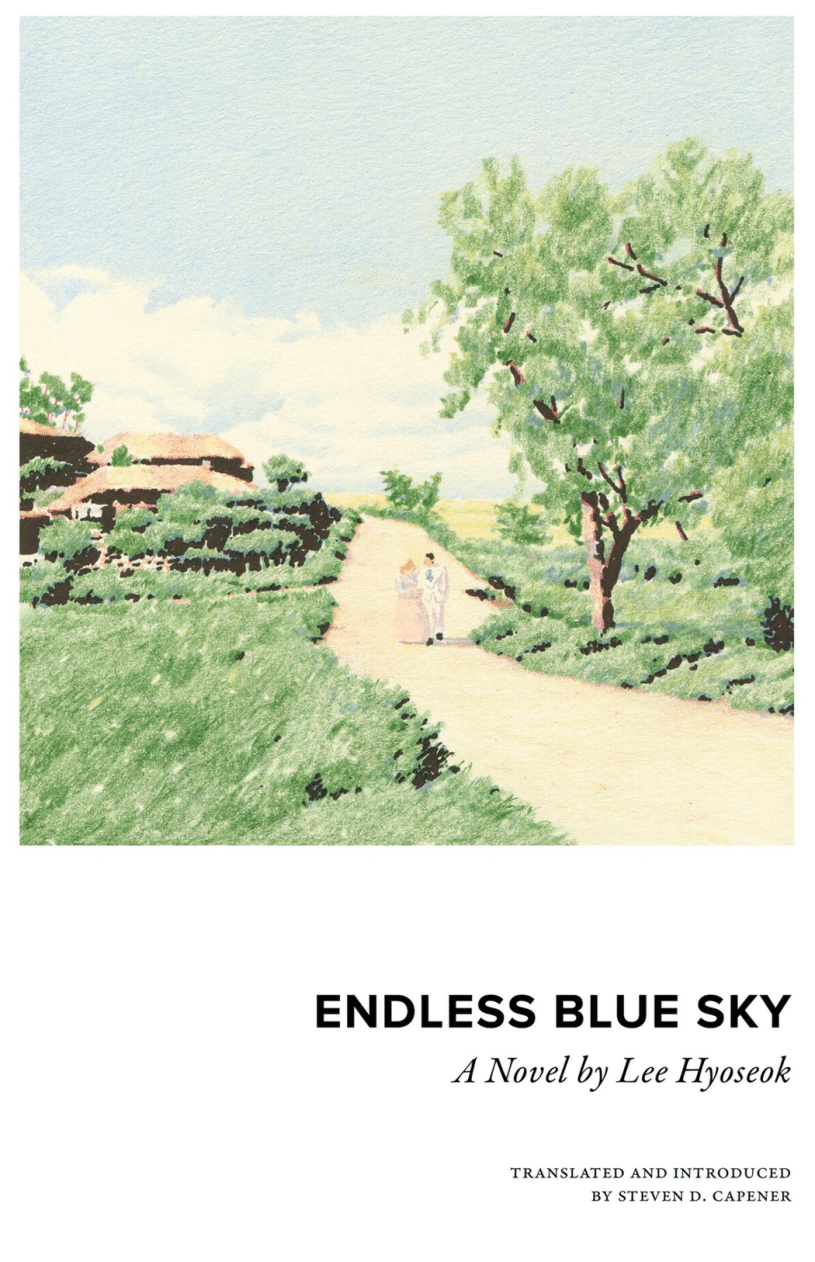
Endless Blue Skies
By Lee Hyoseok
Translated by Steven D. Capener
(1940-1941, translated 2018)
Honford Star
Lee Hyoseok wrote the progressive romance Endless Blue Skies and published it in installments in the Maeli Times from January of 1940 to July of 1941. The central character is Cheon Ilma, a handsome, reserved intellectual, who, unlike his college friends, has been making ends meet here and there but has not found steady work in a rewarding career. As the story begins, he is heading off to Manchuria bearing an invitation from the Hyundai News to a western-trained orchestra to perform in Seoul. And in that task lies Lee’s essential theme: Seoul is a backward and stunted culture that is choking on tradition. For the people and the nation to grow, it must develop a taste for western attitudes and fully engage in a modern, global economy of ideas. As he prepares to board his train, he meets his college friends who have come to send him off and refers to himself for the first time as a “culture broker.” They wish him good fortune, and after he boards the train, they hope he might find love and finally get over the great heartbreak of his life: losing his first love, Miryeo, to a successful businessman. Unbeknownst to him, a would-be lover, the second-rate actress and femme-fatale, Danyeong, has booked passage on the same train. Ilma rejects Danyeong’s coarse overtures, a pattern he will repeat throughout the novel. Arriving in Harbin, Ilma completes his business and reconnects with the charming Nadia, a fantastically beautiful (and blonde!) Russian girl who expresses an attraction for all things Korean, including its language, food, and culture. They share a gloriously sensuous but chaste night of waltzing and the next day, the reserved Ilma breaks character to wager twice: once on a long-shot horse and the other on a lottery ticket. He wins both, and his new economic stability gives him the courage to propose to Nadia and take up lodgings in Seoul. At this point, the fortunes of Miryeo and Danyeong come to the fore. Less than ten years in, Miryeo’s marriage to the millionaire industrialist has become a mere sham. She feels trapped and limited by her role, and when her husband runs off with a kisaeng, she takes the lead in divorcing him. Danyeong’s obsession with Ilma explodes into a full-blown mania, imperiling both his safety and his marriage. After suffering a sexual assault by a producer, the actress attempts suicide. Lee relies on the most unbelievable of coincidences, but as absurd as they are, they allow him to write about the sexual desire of women in a remarkably daring way, while also giving these two fascinating subplots where they manage to recreate themselves and enjoy new relationships while also pursuing meaningful careers in an all-female environment. As these rivals come together to support one another, Ilma and Nadia find their international romance bolstered in every way. Melodramatic, repetitive, and featuring almost preposterously hopeful resolutions, Lee’s novel gives us a surprising look at Korea and Japanese-occupied Korea. Perhaps the most interesting moment in the novel comes when Miryeo and a friend watch the French movie Southern Carrier, directed by Pierre Billon and released in 1937. The film tells the story of a modern woman who, having the opportunity, decides to escape her loveless marriage and begin a new life and love in France. The ideas in that movie are expanded on throughout the novel, and even many years later, Miryeo will speak about how this French film radically changed her vision of individualism and marriage.
“Watching that beautiful story for an hour and a half, Miryeo, as if she had discovered some important truth, felt a mixture of frustration and satisfaction – for some reason she felt simultaneously pleased and vexed. As she walked down the hallway with Hyeju, she asked, ‘What do you think of their solution?’ ‘Well, I can’t say that it’s wrong. If you were to ask me what else they could have done, I wouldn’t have an answer.’ ‘This is like a new discovery to me. Like the feeling of finding a new continent. I’ll never forget this movie as long as I live. When I go home, I’m going to cry all by myself.’”
 East Asian Literature in Translation