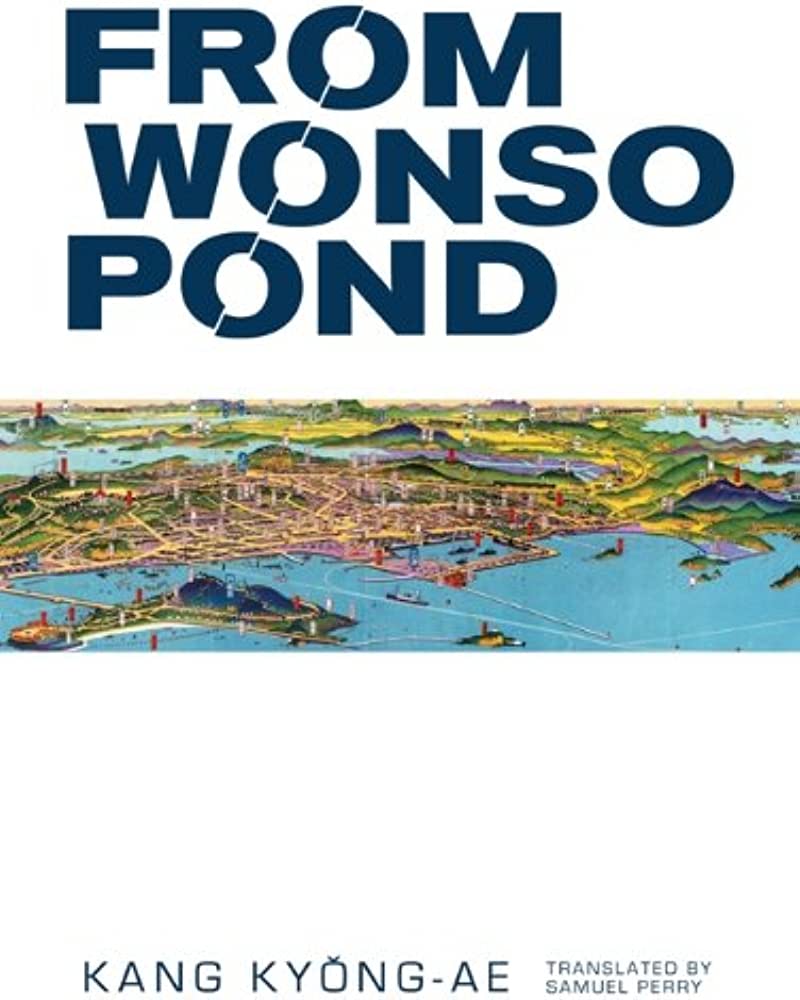
From Wonso Pond
By Kang Kyong-Ae
Translated by Samuel Perry
The Feminist Press
1934, translated 2009
From Wonso Pond is remarkable for any number of reasons. It is the first work of a Korean woman writing in the 1930s to be published in English. The settings of the novel are also significant, as the first half of the novel takes place in the South Hwangwae Province in what is now North Korea. This is also the first province to be visited by Protestant missionaries. The novel also portrays shocking class conflicts as the result of exploitative landlords in the country or greed-driven factory owners in the city. Like other novels from this period, the work appeared serially in newspapers. The story begins as a country romance in Yongson Village, which is under the control of an abusive and exploitative landowner Chong Tokho, who uses every available tool at his service, whether it is the law, a small army of debt collectors, or outright theft and murder to drain every last coin from the laborers who work his fields. Chong is married and has an attractive but self-centered daughter, Okcham, whom he sends off to college. One summer she returns home from Seoul with a young man in tow, Sinch’ol, a teacher she met at university. Sinch’ol, who views himself as a modern philosopher and a socialist, is a directionless and emotionally detached young man who possesses neither the desire to be with the materialistic, vain, and marriage-minded Okcham nor the decency to break with her and her family. As the family fusses over their guest as if he were already their son-in-law, the academic finds himself smitten with the penniless orphan Sonbi, who is now eighteen and a servant of Chong Tokho. Stimulated by the fantasy of possessing and marrying this pure, unschooled daughter of nature, Sinch’ol begins to obsess over the maid, so much so that he agrees to extend his tepid relationship with Tokho’s daughter in order to be able to be in Sonbi’s orbit–even though he has never dared even to speak with her. Inevitably, it is revealed that Tokho has raped young Sonbi, as he raped her friend Kannon before her. When Tokho’s wife discovers that he has taken another maid as a concubine, she threatens Sonbi with death. Friendless, the girl decides to follow in the steps of her friend and mentor, Kannon, who, after being ruined by Tokho, fled to the port city of Inchon, where it is rumored that she has found factory work. When Ch’otchae, a woodcutter who has loved Sonbi since meeting her as a child, discovers what has happened, he too heads for Sinchon, where he finds work on the docks. With grit and faith, he hopes to make money and rescue Sonbi. Meanwhile, Tokho makes a formal visit to Sinch’ol’s parents and informs them that their son spent the summer at his home and that he and his wife expect that Sinch’ol will soon propose to their daughter, Okcham. Ch’otchae’s father is thrilled: marrying into the family of Tokho would be a political and financial coup. But when he tells his son of Tokho’s visit, Sinch’ol informs him that he has no intention of marrying Okcham and that he is instead devoted to a penniless servant with whom he has never spoken. Outraged by his son’s romantic delusions, he vows never to give him a cent and throws him out on the streets of Inchon. Homeless and starving, the dilettante finds himself living first on the streets and then in a single room with a clutch of alcoholic, socialist writers. The finale ends up with a series of portraits of the manner by which factory and dock owners exploit the male and female proletariat, including of course, the angelic mill worker, Sonbi, and the two men who are pursuing her: tireless and noble, Ch’otchae, the salt of the earth, and the feckless scholar, Sinch’ol. In the end, this novel is a tale of the need for socialist reform, resistance, and revolution–a startling turn in a novel that appears to be a romantic melodrama. Imagine Dickens and Marx and you have From Wonso Pond.
“And what kind of people were these comrades of hers, anyway, who she hadn’t even met yet? Were they people like Ch’otchae? Maybe Ch’otchae was one of them? But judging from the time she’d seen him on her way to Wolmido, Ch’otchae seemed to be working as some sort of day laborer, instead of in a factory. Most likely he had never met one of the leaders . . . Sonbi assumed that Ch’otchae was simply trying to keep himself busy, and hadn’t yet found the path which would lead him out of the darkness. And when Sonbi thought about Ch’otchae in this way, she wanted to meet him more than ever. More than anything she wanted to bring him into class consciousness. She knew he was likely to become a fearsome fighter, far stronger than anyone she knew.”
 East Asian Literature in Translation