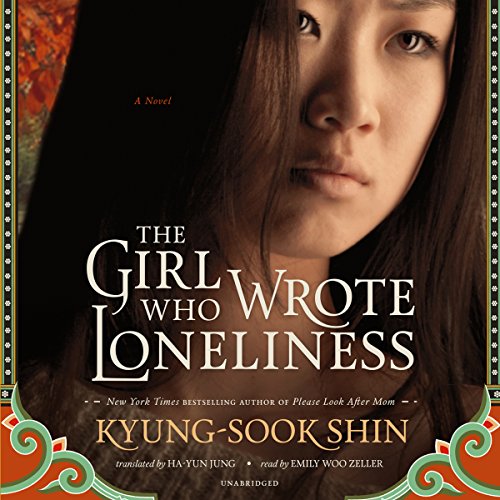
The Girl Who Wrote Loneliness
By Shin Kyung-sook
Translated by Jung Ha-yun
(1995, translated 2015)
Pegasus Books
Shin Kyung-sook is the author of Please Look After Mom (2008, translated 2012 ) I’ll Be Right There (2010, translated 2013 ), reviewed in this project, as well as a series of South Korean YA novels. I’ll be Right There is a quasi-autobiographical work of fiction about a group of college friends who come of age in the 80s and 90s in South Korea. The Girl Who Wrote Loneliness is more directly an autobiographical piece. The central conceit is that the narrator, a writer who has achieved some degree of independence and success, receives a letter from a woman with whom she once worked, who asks if perhaps she might consider writing about the period of time when they and other young women worked at Dongnam Electronics making circuit boards. The voice from the past opens a door into the narrator’s unconsciousness that had been closed for many years: a period from 1978 to the early eighties, when she left a country home for which she still longs, to work in a factory on Jejo-do island. She spends long days in the all-female factory working in unsafe conditions under autocratic male supervisors who short the women’s pay at the slightest hint of disrespect or failure to meet quota. Abusive and mercurial, they also sexually harass the workers, so it is not surprising that the women begin to talk of unionizing, an activity that could result in jail or worse under the leadership of Park Chung-hee. The narrator lives in a small, increasingly crowded apartment with an older brother who seems to only tolerate the presence of his sixteen-year-old younger sister, who arrived at his doorstep all but unannounced, having landed her first job by lying about her age. As workers begin talking more openly about their grievances, the narrator begins taking high school classes at night–a choice that puts a significant distance between her and the young women who are organizing protests. But what about her college-age brother? Is his open resentment of her genuine, or is he up to his own political activities and trying to shield this young girl from any repercussions should he be discovered? Writing from the perspective of 1995, the narrator of The Girl Who Wrote Loneliness discovers that the more she writes about her past the more she remembers, recalling people, stories, and events that she had locked carefully away, including the assassination of Park Chung-hee in October of 1979 and the ensuing Seoul Spring Protests for democratization which continued through May of 1980, climaxing in the government’s decision to open fire on protesters in Gwangju, which resulted in the deaths of between 600 and 2,300 citizens–figures still hotly debated because of reports that soldiers were ordered to destroy the bodies of the dead. Shin approaches the period with trepidation and respect. Although she finds comradery in the factory, her time in her cousin’s apartment becomes increasingly anxiety-ridden. She longs to escape those four walls, but at the same time, she has nowhere to go, and there is no sanctuary where her conversations might run free. As with I’ll Be Right There, Shin succeeds in recapturing a past that is marked by the narrator’s increasing sense of anxiety coupled with a sense of paralysis. The protagonists observe, but cannot act, and that distance or lack of agency exhibited by the hero is difficult to live with. Perhaps Shin’s documentation of her peculiar inaction may be the most honest way to revisit one’s small role amid history-making events.
“The images from the video of the Gwangju incident that I happened on that day presented me with a great shock and helped me realize what it was I had to do for the people and history on the road to democratization. Numerous people were taken by force under the guise of social purification and struggled to survive for three, five years at Samcheong Training Camp, a scene of bloodshed brought about by an unjust law that served to create an atmosphere of fear in the course of the birth of a new regime. I plead, and pray, from deep in my heart that a campaign as tragic as the Samcheong Training will never take place again in this land, the way it did in 1980, a year when humanity, morality, and democracy were obliterated.” 233
 East Asian Literature in Translation