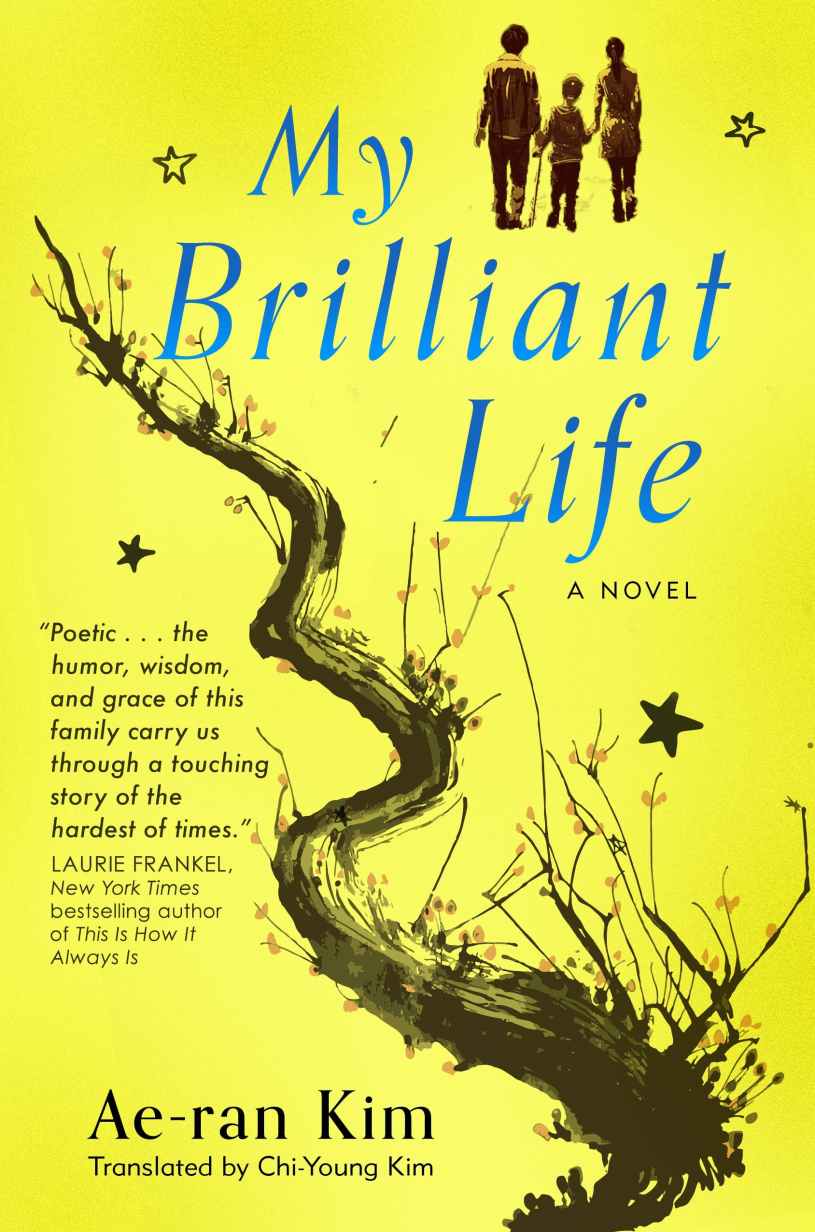
My Brilliant Life
By Kim Ae-ran
Translated by Kim Chi-young (f.)
(2011, translated 2022)
Forge Books
Novel
The narrator of Kim Ae-Ran’s novel is an only child, a sixteen-year-old boy with a keen sense of symmetry. Ah-reum takes up his writing at the same age his parents conceived him. He begins his story by telling about how his parents met. The pregnancy was of course unplanned and resulted in his mother’s immediate dismissal from school. When her five brothers discovered her condition, they almost beat Ah-reum’s young father to death. A domineering and resourceful grandfather allowed them to live under his roof in a small room while renting another shelter to the itinerant workers who came in to develop the area. The young father who had no real skills or intelligence and was prone to violent outbursts found work as a laborer on the developer’s many crews. The influx of temporary and permanent workers into the small town disrupts the local order, creating power imbalances and leading to changes that can not be undone. One of the most significant is that the building project redirects the local waterway and permanently submerges one portion of the small town Meanwhile, Ah-reum reports that his mother continued to weigh the pros and cons of having a child. She is unable to decide whether to have the baby or not, but eventually, the matter is decided for her when doctors discover that she has preeclampsia, a condition thati imperils the lives of both her and her child. They inform her that the best course of action is to risk giving birth. And so it is that the premature Ah-reum describes to us his birth, his mother’s first words to him, and the joy that runs through the family when they hear that the mother and son are healthy. When Ah-reum shifts to telling us about his present life at sixteen, he tells us about the value he places in books, his isolated life, and the lengths to which his father and mother to protect him from insensitive people. Matter-of-factly, he also explains that he has lost almost all his teeth, a result of a disease that will likely kill him before he reaches eighteen. Han Ah-reum was born with progeria. He has difficulty gaining weight and suffers a tightening of the skin around his stomach and chest. He also loses his hair, and his bald head seems perilously large atop a body that has failed to thrive. Testing leads to the diagnosis of progeria, a rare gene mutation that would cause their son to age rapidly. His intellect would be unaffected, but the disease would weaken his bones and joints. He would find it increasingly hard to move and use his muscles, and he would likely die by his mid-teens. My Brilliant Life is Han Ah-reum’s love letter to his parents and family. Kim’s hero is a remarkably loving and endearing person who finds joy every day of his life. His gratitude toward his parents is palpable and his positivity is uplifting. Kim reveals the young man’s battles with loneliness, anxiety, and depression, but that takes a turn for the better when a reality TV show runs a story on his condition. This leads to a flood of generous donations and letters from those who offer their condolences or wish him well, an event that buoys him and his family. Several writers begin communicating with him regularly, but in time, one’s messages begin to touch the young man at his core, and so the two begin an epistolary friendship. Kim’s hero is extraordinary in his mental strength. He expresses his love in a language that is plain-spoken and profound in its simplicity, and though Ah-reum suffers the unthinkable, he succeeds in making his story a tribute to the sacrifices of his loving family. The novel was quite successful; in 2014, Lee Je-yong directed a film version of the novel.
“My grandfather urged my dad to graduate. Since he would get kicked out of his program for impregnating a girl, he could enroll in a nearby school and at the very least get a diploma. Unfortunately, rumor and gossip travel at lightning speed and no school was interested in taking him, claiming that a student like my dad would damage their reputation and set a bad example for the other kids. My grandfather, who assumed his recommendation as a village leader would prevail, was humiliated by the rejection and ended up suggesting working in construction while studying for the high school equivalency exam.”
 East Asian Literature in Translation