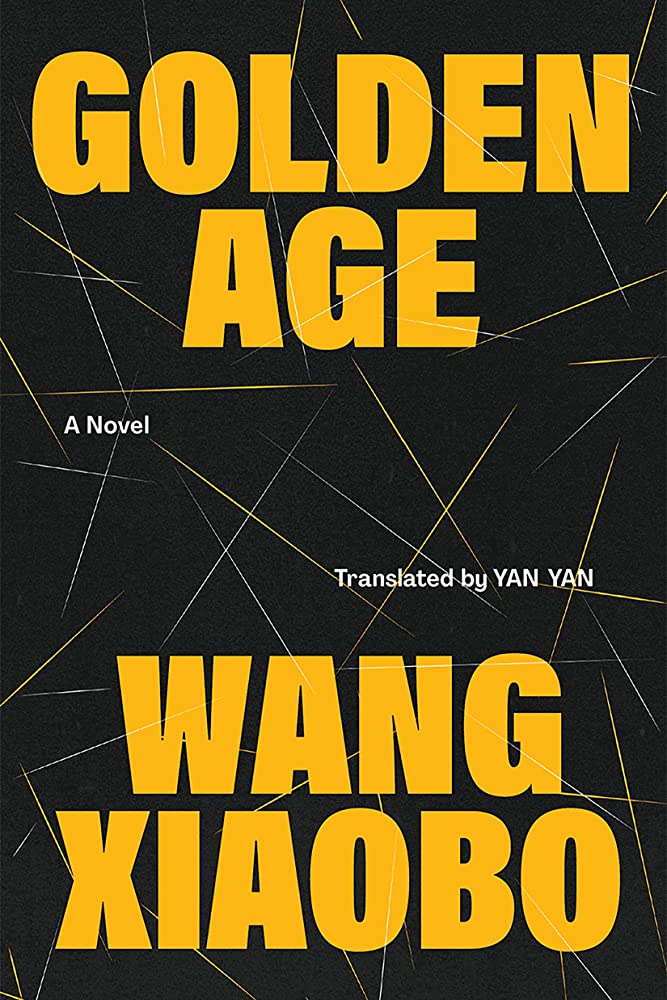
Golden Age
By Wang Xiabo
Translated by Yan Yan
(1992, translated 2022)
Astra House
(Novel)
Wang Xiaobo, a prolific essayist and writer, ranks as one of the most successful and beloved writers of his age. Born in 1952, he had the misfortune of dying of a heart attack in 1997. He was 44 years old. A Beijinger born and raised, he did his undergraduate work at Renmin University. In 1986, Wang went to the US, where he earned a master’s degree at the Center for East Asian Studies at the University of Pittsburgh. After graduating, he traveled throughout Europe and returned to China in 1988. The Golden Age is a novel about the Cultural Revolution. As in other novels of the period, the story (or stories) are told in a non-linear style, with the first-person narrator hopping back and forth in time to relate the complexity and unpredictability of his experiences. Wang’s characters speak in a vernacular that is expressive, crude, and often hilarious. The author’s primary lens through which to view the dehumanizing forces of the Cultural Revolution is human desire. The hero, Wang Er, chronicles his life not by an accounting of political movements, shifting occupations, reversals, or imprisonments, but by his attachment to different women: Chen Qinyang, the ever-rational doctor assigned to the commune where he is sent to work as an ox driver, the elusive “Bicycle Belle,” who craves her independence and is always just out of reach, and the breathtaking “Line,” whose name is synonymous with the graceful flow of her body, and others. Caught up in the turbulence of the time, Wang Er fights back against the forces that strip him of his identity and free will by engaging in illicit sexual acts. When premarital sex is outlawed, he refuses to check the desires of his “little monk” and sets himself the task of seducing Dr. Chen, a twenty-six-year-old beauty who has already fallen afoul of the locals and is being denounced as “an old shoe” or prostitute. Furious that she is unable to defend herself against these false accusations, it occurs to her that her wrongful suffering might be more bearable if she were actually involved with someone with whom she can have sex but never love, thus maintaining a type of virginity. A true philosopher of the school of Moliere, Wang Er helps the beauty as she puzzles through her options and eventually convinces her that they should not have sex because they are in love with one another, but because they are restoring the ancient concept expressed in the epic of The Water Margin, of the “Epic Friendship.” Having committed to the act philosophically, the two must discover a trysting place beyond the ever-present spies of the party where they can cement their epic friendship and make revolution. The couple experiences a kind of Eden in the mountains behind their commune, but they are soon discovered and imprisoned. When their captors demand confessions. The two accounts of their affair jibe, and after a stunning confession, the officials release Dr. Chen. However, as word of the salacious writing of Wang Er spreads hither and yon, higher-ups order local party officials to demand Wang Er add greater detail to his confessions–and so begins Wang Ers’ life as a pornographer. Eventually, Wang Er earns his freedom, but he loses touch with Dr. Chen. He becomes a chemistry teacher and over time stumbles his way into a kind of life as an ineffective and uninspired academic in a Red university. Not quite numbed by his experiences, he perseverates over the death of a colleague who committed suicide by launching himself off the top of a building. The colleague had been held for questioning prior to this act, and although there was clear evidence that the man had been tortured, the official report made no mention of these wounds. Around this time Wang Er stops using the “I-voice” and begins telling the love story of Old Liu and Line, an impossibly difficult relationship between a woman of exquisitely vital beauty and a decrepit old man whose body is perennially coated in coal dust. Golden Age is made up of many set pieces that are both hilarious and heartbreaking. At times I struggled to find where I was in time and needed to double-check to fully understand Wang Er’s career and his follies, and I might not be able to tell a friend what the story is “about.” However, I believe I’ll cherish this reading for a long time. Incidentally, Wang Xiaobo and his wife, Li Yinhe, wrote a widely disseminated study on homosexuality in China and advocated for the official acceptance of China’s homosexual citizens. In 1996, he published The Silent Majority, in which he argued against China’s attempts to silence sexual minorities and all minorities. In doing so Wang and Li became icons of the LGBTQ+ communities in modern China.
“It was then that I remembered that Team 15’s Chen Qingyang was a graduate of the Beijing Medical University. I figured she could probably tell a needle from a fishhook, so I went to her to get treated. It wasn’t more than thirty minutes after I returned from the doctor’s visit that she came barging into my hut, asking me to prove that she wasn’t an old shoe…
Chen Qingyang said, it wasn’t that she had anything against loose women. As far as she could tell, they tended to be kind, helpful people who hated to let anyone down. She had some admiration for them. But the point wasn’t if they were worthy women or not, it was just that she was not one of them. It was just like how cats weren’t dogs. If a cat had found itself being called a dog, it also would have felt uncomfortable. With everyone calling her an old shoe, even she herself was beginning to question what she was.”
 East Asian Literature in Translation