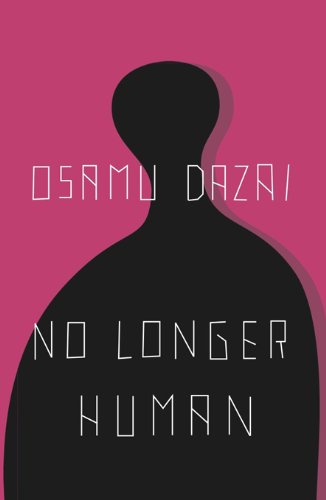
No Longer Human
By Dazai Osamu
Translated by Donald Keene
(1948, translated 1973)
New Directions
(Novel)
Dazai’s No Longer Human is an especially challenging read. First, it is a story about a directionless, self-loathing man who is bent on his own destruction and who is complicit in the death of one of his innocent and well-meaning lovers. It is also a story about a depressive alcoholic who uses and is used by many different people, and the world he inhabits is perennially dark; his character arc is a precipitous downward spiral that predictably ends in a virtual erasure of the self. Because of the repetitive cycles of manic and depressive thinking and action, it can be a struggle to pick out a plot line. And, at two points, the narrator refers to events of extraordinary significance in a very indirect manner. Also, it is essential to know Dazai’s personal history. No Longer Human is not an autobiography per se, but it closely follows Dazai’s own struggles with alienation, depression, addiction, and self-destruction. And it is essential to know that just like his character Oba, Dazai and a young woman made a suicide pact, and she died and he survived; Dazai ended his life at the age of 39, the year the novel was published. The novel is divided into three “memorandums.” In the first, the narrator reveals that, from the beginning of his life, he saw that it was impossible for him to fit into his family, school, or human society. In order to survive this painful existence, he adopted the trick of playing the fool and wearing a mask of carelessness. It is in this first period of the narrator’s life that he attempts–and fails–to confess that he was sexually abused by the family’s servants, one male, and the other female. In the second memorandum, Oba finds a friend, Takeichi, who sees through his disguise. As he comes to trust Takeichi, Oba reveals what he calls his “ghost” paintings. Takeichi encourages Oba to pursue his artistic ambitions, and later, in an art class, Oba meets and comes under the influence of Horiki. Horiki is a working artist with his own issues; he quickly introduces Oba to bouts of hardcore barhopping which almost always end in a visit to brothels. Soon after, Oba stumbles into an affair with a married woman. In love with their misfortune, the two determine to drown themselves, and though they are both in earnest to put an end to their suffering, Oba “fails.” In the third memorandum, Oba begins a relationship with a single mother. Although he appears invested in taking on the roles of husband and father, he abruptly abandons the family and throws himself at the feet of a madame who manages a bar. He begins drinking again, making a few dollars here and there composing empty verse. A young girl, Yoshiko, expresses pity for his depressed state and addiction to drinking and vows to protect him from his own ruinous habits. Unfortunately, his old drinking companion, Hiroki, tracks him down. During this visit, first Horiki and then Oba witnesses a sexual assault on the angelic Yoshiko. Neither interferes and shortly after, Oba returns to drinking and whoring. Eventually, he becomes addicted to morphine and is placed in a mental institution. On his release, he determines to leave society and become a hermit. Dazai begins and ends these stories with an introduction and conclusion by a third-person narrator who claims to have come across pictures of Oba from his early life; having been struck by the ambiguity of the young man’s smile, the narrator becomes curious about what became of this strangely out-of-step young man. At the end of the last memorandum, the narrator returns as if to confirm the truth of all that we have read by reporting that he happened to meet a person who once knew Oba.
“But here again the face fails inexplicably to give the impression of belonging to a living human being. He wears a student’s uniform and a white handkerchief peeps from his breast pocket. He sits in a wicker chair with his legs crossed. Again he is smiling, this time not the wizened monkey’s grin but a rather adroit little smile. And yet somehow it is not the smile of a human being: it utterly lacks substance, all of what we might call the “heaviness of blood” or perhaps the “solidity of human life”—it has not even a bird’s weight. It is merely a blank sheet of paper, light as a feather, and it is smiling. The picture produces, in short, a sensation of complete artificiality.”
 East Asian Literature in Translation