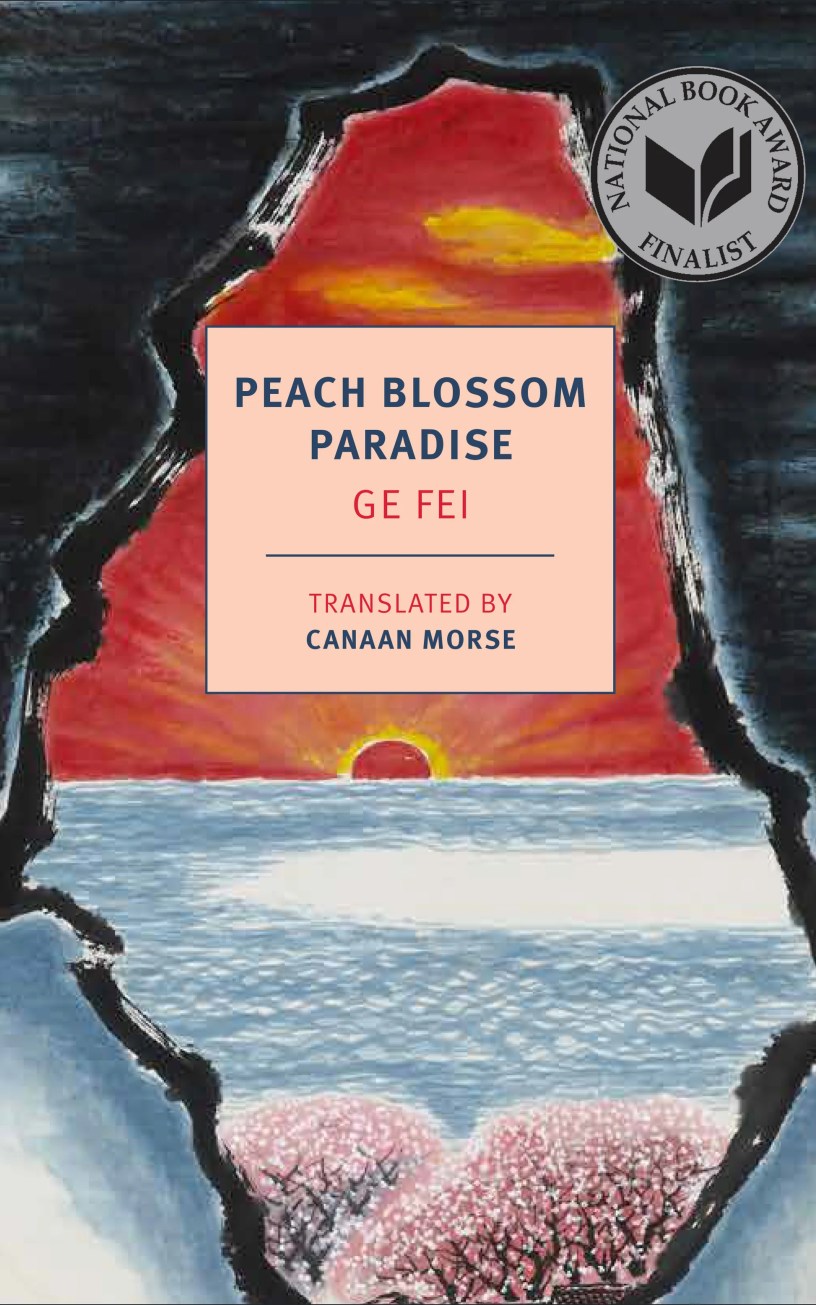
Peach Blossom Paradise
By Ge Fei
Translated by Canaan Morse
(2004, translated 2020)
NYRB Classics
(Historical Novel)
Ge Fei’s Peach Blossom Paradise is a historical novel and the first in his Jiangnan Trilogy. Before reading this novel, it may be useful to know that Ge is known for his experimental style. His novella, A Flock of Brown Birds, is enigmatic, episodic, and repetitious, and exploits the grieving narrator’s sense of inhabiting a timeless space. Ge was strongly influenced by Kafka and wrote non-fiction about the author and his works. The title, Peach Blossom Paradise, refers to the “Peach Blossom Spring” myth from early China, where a fisherman searching for his next meal accidentally discovers a stream that leads him into a marvelous world where the surface of the water and the land is covered entirely in peach blossoms. There he encounters the people of a tribe that has never known war or suffered privation. After enjoying the hospitality of the people of Peach Blossom Spring, he is permitted to leave, on the condition that he never tells anyone how to find their peaceful hideaway. He keeps his promise, yet he soon longs to return. Sadly, he is unable to retrace his route. Ge sets his story so that events take place relative to China’s Hundred Days Reform, which took place in 1898 at the end of the Ching dynasty and culminated in a military coup led by Empress Cixi. Ge does not directly refer to these historical events, though at times he includes footnotes that place some of the secondary or tertiary characters within the history of the doomed revolution. Ge instead introduces us to a series of fictional characters who each experience a powerful drive to create a paradise in the form of a utopian government. Complex plots swirl, secret societies exchange tokens by which they can be identified, spies walk the land, agents are exposed, and heads roll. In spite of the agitation, and the ever-present impulse to tear down the old and make revolution, Ge portrays a world where nothing changes. Individual lives may be lost and family fortunes may vanish overnight, and there will be many who call for justice, but inertia reigns. To some extent, the characters who choose to create a new world order are portrayed as heroes and as men or women possessed by a peculiar madness. Indeed, the first character Ge introduces us to is a patriarch who nurses a bitterness he has suffered since a political shift cost him a government position. He isolates himself from his family, talks to himself, experiences a variety of contradictory health-related crises, becomes a flight risk, and finally walks out the door of his home, never to be seen again. Ge’s protagonist is that old man’s daughter, the unforgettable Xiumi. She is at the heart of the story, and she shines for the greater part of the plot. She always seems aware that actions of great historical significance are occurring all around her, but her gender and her age keep her away from the central forces which generate the waves of violence which crash over the village of Puji. Eventually, she does learn of various revolutionary schemes, but only long after cabals are outed and leaders massacred. She is sought by many men, and though at times she expresses a desire for bodily autonomy when her mother announces she is to be wed to a man she does not know, she offers no resistance. Ironically, as she is carried by palanquin to the home of her new husband, she is kidnapped by robbers and taken to a secret island. There, she learns of the origins of the robber clan, their commitment to preserving their own iteration of a Peach Blossom Paradise, and their intentions to turn her into a prostitute. An old nurse/Buddhist priest consoles the frightened woman, explaining that it is best for women to accept their role and suffer degradation. After all, according to the nurse, if she is not defiled by one man, it will be another. When the young maiden asks how does one survive? The nurse explains that for her, the trick is to recite sutras and separate one’s self from one’s body. That advice could speak for all of China during this period of upheaval that set the stage for the waves upon waves of reform and revolution that were about to rage across China for most of the 20th century. Xiumi manages to escape the bloody auto de fe that sounds the crack of doom for the robbers’ Paradise, but how is something of a mystery. We learn that she fled to Japan. On her return, the character is revealed as someone who has profoundly changed. She no longer responds to her name and insists on being referred to only as “the Principal,” and like so many of the men of Puji before her, she has become obsessed with her own vision of a utopian China. She immediately begins to gather the various forces that have grievances and assembles an arsenal. Ge’s writing is exquisite. He portrays characters and landscapes beautifully, and his descriptions of the spy work and countermeasures are entertaining and suspenseful. Readers may be challenged, as I was, by abrupt leaps through time and space. For example, at one point she is imprisoned by the state, and then a few pages later she walks out a free woman. And why did Xiumi go to Japan? How long was she there, and what caused her to reinvent herself as the Principal? These lacunae left me frustrated. Nevertheless, I was captivated by the final movement of Ge’s novel. Xuemi’s Peach Blossom Paradise has self-destructed. The broken Xiumi, rendered mute, returns to her home in Puji and begins to rebuild her relationship with her family’s old servant, Magpie. These are the most lyrical and magical moments in the novel a wondrous counter to Ge’s theme that revolutions are more cancer than cure.
“So, what do you mean by ‘revolution?’” Tiger asked, after a pause.
“Ah, revolution…” The Principal rubbed her temples, as if her head started to hurt again. “Revolution is when no one has any idea what they are doing. You know you’re making revolution, it’s true, but you have no idea what’s going on. It’s like…It’s like a centipede that crawls over the walls of Black Dragon Temple every day. It knows every part of the temple, every crack and cranny, every single brick and tile. Yet if you asked it, “What does Black Temple Dragon look like’ it couldn’t answer you. Understand?”
 East Asian Literature in Translation