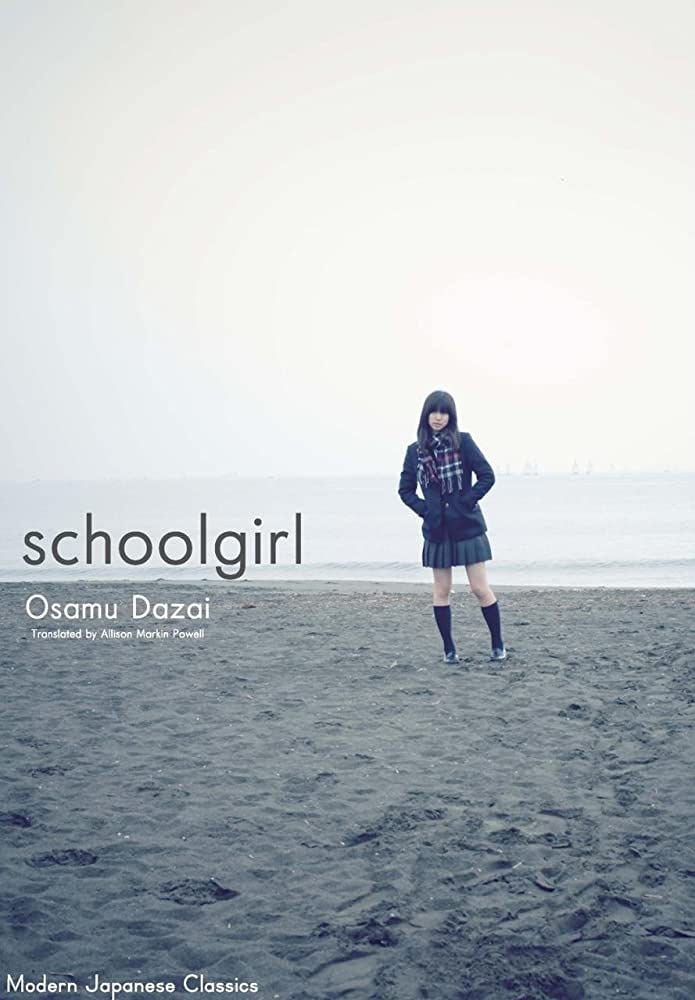
Schoolgirl
By Dazai Osamu
Translated by Allison Markin Powell
(1939, translated 2011)
One Peace Books
(Novella)
Osamu Dazai’s Schoolgirl is one of his earliest works to be published. It caused a sensation when it first appeared; I first noticed it when a young woman is shown reading it in a scene from Kichitaro Negishi’s 2007 film, Dog in a Sidecar. Dazai’s story covers a day in the life of a young Japanese schoolgirl. The nameless child struggles with mornings; opening her bleary eyes and trying to focus brings her a sense of both excitement and dread. Nearly blind without them, she likes her glasses because they conceal what she dislikes most about her face. Donning her school uniform and grabbing her mother’s parasol, she dashes out the door imagining she is walking through the streets of Paris–until she must pass some workmen whose stares disrupt her fantasy. School is a rollercoaster ride of daydreams, social awkwardnesses, and boredom. She returns home to cook for the guests of a mother from whom she craves attention, luxuriating in the process of creating a beautiful meal while also certain that it will be tasteless, despite the praise from her mother’s friends. Although it focuses only on a single day, it brilliantly captures the highs and lows of the teenage experience. Dazai, who was 30 when he wrote this bestseller, strikes a false note here and there, but otherwise, his portrayal of the girl’s thoughts is a tour de force. Critics and scholars compare the narrator’s paradoxical expressions and mercurial moods to Salinger’s Holden Caulfield in The Catcher in the Rye.
“The truth is that I secretly love what seems to be my own individuality, and I hope I always will, but fully embodying it is another matter. I always want everyone to think I am a good girl. Whenever I am around a lot of people, it is amazing how obsequious I can be. I fib and chatter away, saying things I don’t want to or mean in any way. I feel like it is to my advantage to do so. I hate it. I hope for a revolution in ethics and morals. Then, my obsequiousness and this need to plod through life according to others’ expectations would simply dissolve.”
 East Asian Literature in Translation