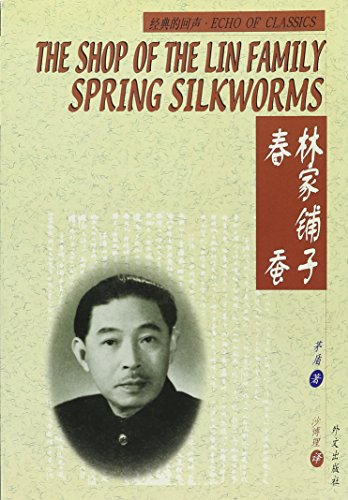
The Shop of the Lin Family and Spring Silkworms
By Mao Dun
Translated by Sydney Shapiro
(1932, Bilingual Edition 2001)
Foreign Language Press
Mao Dun was a member of the May 4th movement of 1919, a student uprising in response to China’s ceding of territory to comply with the Treaty of Versailles. He was a Chinese Nationalist and counted himself a Realist, and was compared to Emile Zola. In 1949, he was tapped to be China’s Minister of Culture, which he held until the Cultural Revolution in 1966. The Shop of the Lin Family focuses on the troubles of the hard-working and honorable Mr. Lin, his wife, and his eighteen-year-old daughter. Their village, like all of China, is suffering from an economic collapse. He has products to sell, and it seems the best of them are imported from Japan. He also owes money to the bank and several other lenders, and though he has also lent money to other small businesses, the economic crisis all but guarantees they will be unable to pay. To complicate matters, the Anti-Japanese Invasion Society, which lobbies against the Japanese invasion of Manchuria, charges that those selling Japanese goods are traitors. Locals begin harassing him for carrying these products; frustrated that he is being targeted when every merchant is doing the same, he solves this problem handily by cutting out the “Made in Japan” labels. He is a resourceful merchant, and he has a devoted staff. Shousheng is a standout. Handsome, reliable, and quick-thinking, he does everything he can to protect his employer. In spite of their spirited defense, the capitalist melodrama churns on, presenting a textbook example of “The big fish eating the little fish.” One may wonder if Lin himself is being held up for criticism. Perhaps. But it is clear that Dun’s primary target is the Guomindang. They appear to be behind the push to imperil the livelihood of the Lin family. Their unrelenting influence seems mean-spirited and capricious, especially since there are other shops in financial straits, too. The motive behind their malice becomes clear when the pockmarked, oily-looking Guomindang chief sends a go-between to Mr. Lin, offering a solution at the height of his troubles: the debts might be written off and the shop rescued if Mr. Lin consents to permit the old lecher to marry Lin’s lovely daughter.
Spring Silkworms is a shorter tale. Again, we have an honorable, hard-working man as a hero. This time, he is from a much lower class and he, his family, and all the neighboring families whose hopes and labors are tied up on raising and trading silk worms are under the withering blasts of the market. In The Shop of the Lin Family, Mr. Lin knew that the reason for the drop in sales is that the peasants did not have any cash to spend on anything else but food. In Spring Silkworms, we could be looking at Lin’s impoverished target market. Mao Dun draws attention to the high labor cost and risk of raising silkworms. Again and again, he notes that as the silkworms are growing healthier on their costly diet of mulberry leaves, the people in the community are growing thinner and thinner. The author also paints a picture of a people who are devoted to religion and ritual and more aligned with ancient suspicions than scientific knowledge. Despite many obstacles, their herculean efforts yield them enough cocoons to pay back debt and retrieve their winter clothes from the pawnbrokers. Unfortunately, all of the area’s silk filatures have locked their doors, perhaps in response to the plunge in the market, or perhaps due to the malicious efforts of the Guomindang, which is believed to be working hand in hand with the Japanese.
Note: This publication contained many errors. End marks are missing in many sentences and there are a few misspellings in the text. The titles of each work along with a portrait of Mao Dun appear on every right-hand page. Throughout Spring Silkworms, every right-hand page reads “Apring Silkworms.” Halfway through my reading, the binding split in two. The Chinese University of Hong Kong publishes the same translation; perhaps that has been edited more thoroughly and manufactured better.
“If he weren’t ruined it would be a miracle: The Guornindang chieftains were putting the squeeze on him; the bank was pressing him; his fellow shopkeepers were stabbing him in the back; a couple of his biggest debtors were going to default. Nobody could stand up under this kind of buffeting. But why was he fated to get such a dirty deal? Ever since he inherited the little shop from his father, he had never dared to be wasteful. He had been so obliging; he never hurt a soul, never schemed against anyone. His father and grandfather had been the same, yet all he was reaping was bitterness!” – from The Shop of the Lin Family
 East Asian Literature in Translation