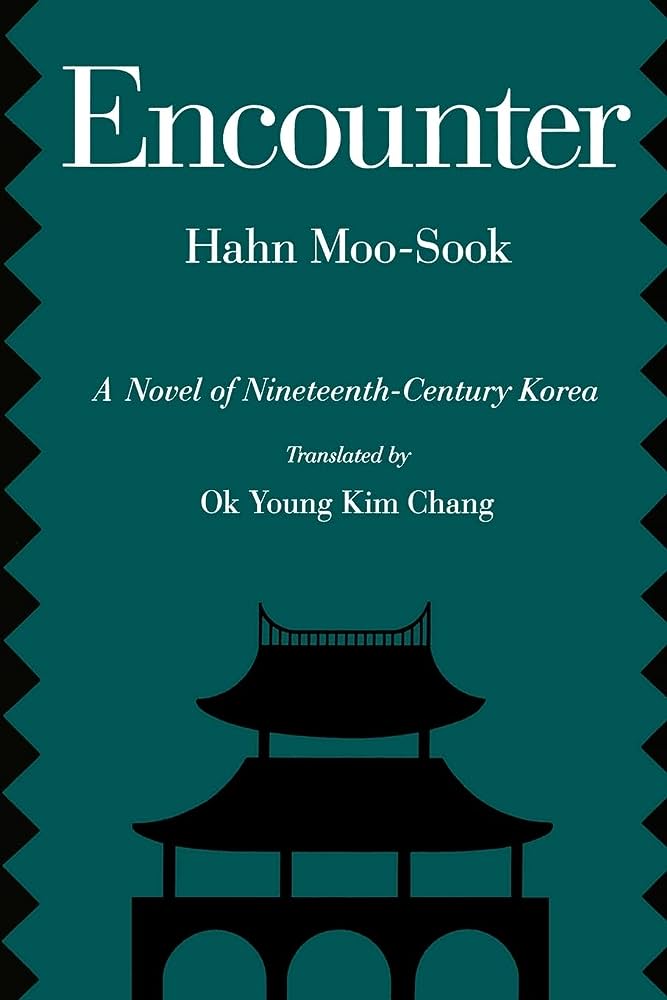
Encounter, A Novel of 19th Century Korea
By Hahn Moo-suk
Translated by OK Yung Kim Chang
(1986, Trans. 1992)
University of California Press
In 1942, Hahn was a housewife in her forties when she submitted her first piece of literature, A Woman With a Lantern, and won a major literary prize. She continued to enjoy great popularity as a playwright and novelist. At a time when most writers were producing dark, nihilistic writing in reaction to the unique chaos and horror experienced by Koreans in the 20th century, Hahn produced works that celebrated life and extolled the power of faith and hope. Encounter is a historical novel about a series of historic crises which almost eradicated Catholicism in Korea. Set in the 19th century, Hahn examines two distinct waves of persecution when Joseon rulers banned Catholics and drove them into hiding. When government agents captured Korean Catholics, they required them to reject their faith or face exile from home and family, long prison sentences, torture, or execution. Hahn tells her story by bringing to life the thoughts and actions of historical figures, including Kim Chong Sun, the Empress Dowager, who created the Edict of Catholic Eradication and the Persecution of 1801, as well as a number of revered Korean martyrs and saints. The central figure in the novel is Tasan, a neo-Confusion scholar of prodigious intellect, curiosity, and influence. Keen to learn all he can from the arrival of new knowledge from the West, he takes up the study of seminal Catholic texts. He is fascinated by the new learning and becomes a Christian along with all of his extended family. When the Persecution begins, he is imprisoned along with family members, good friends, and neighbors. Many refuse to recant their faith and are executed. Tasan chooses to become an apostate and is sentenced to eighteen years in exile. Throughout that time, he ruminates on his failure before his new god and torments himself with the guilt of having introduced a cursed religion to so many he loved. Hahn’s flawed protagonist meets with a variety of travelers and followers during this time including Buddhist and Confucian scholars, fellow exiles who tell him of new threats and the passing of old friends, and hidden Catholics who hope that Tasan will aid them in a new mission to bring a Catholic bishop into Korea. Chong Ha-Sang, the second son of Tasan’s estranged brother, appears before his uncle in his teens, asking for guidance. Tasan is shocked to discover that family members who survived the purge are banned from schools and the once influential family of scholars has become an impoverished collection of illiterate peasants. Yet Ha-sang, inspired by his faith, will not be stopped: through force of will, he becomes an authoritative scholar and leader of the faithful. Other believers accomplish formidable goals, including three orphaned sisters who lose and then find each other and ultimately achieve martyrdom together. At times, The Encounter reads as a Catholic melodrama, and Hahn’s presentation is certainly biased, as she has her Tasan reaffirm his Catholic faith before he dies, while there is no evidence from the life of the historical Tasan to confirm that he did. Nevertheless, The Encounter is an important novel for anyone interested in Korea in the 19th century. Her evocation of the time period is rich in exquisitely rendered detail. She is a master of bringing to life astonishingly beautiful descriptions of landscapes, weather fair and foul, huts, palaces, and prisons. She also takes us deep into the minds of her characters, revealing deep doubts and moments of transcendent passion. Most importantly, she sets up a balanced and complex dialogue about the desire for faith and the various belief systems of the period, introducing us to the beliefs and practices of shamanism, Buddhism, Confucianism, and Catholicism.
“As usual, Tasan was immersed in reading in his room, which was dark even in the middle of the day. The books piled near his desk had been borrowed from the library of his maternal clan, for which he had to work twenty-five miles and endure the displeasure of unwelcoming kin. Even the small writing table and the ink-slab were pieces that had been abandoned in their barn, and that he had salvaged and repaired.
Watching the scholar preoccupied with reading in a windowless room–and how could one read in darkness?–P’yo often wondered if Tasan might not indeed be a heretic who practiced magic as they said Catholics did…”
 East Asian Literature in Translation