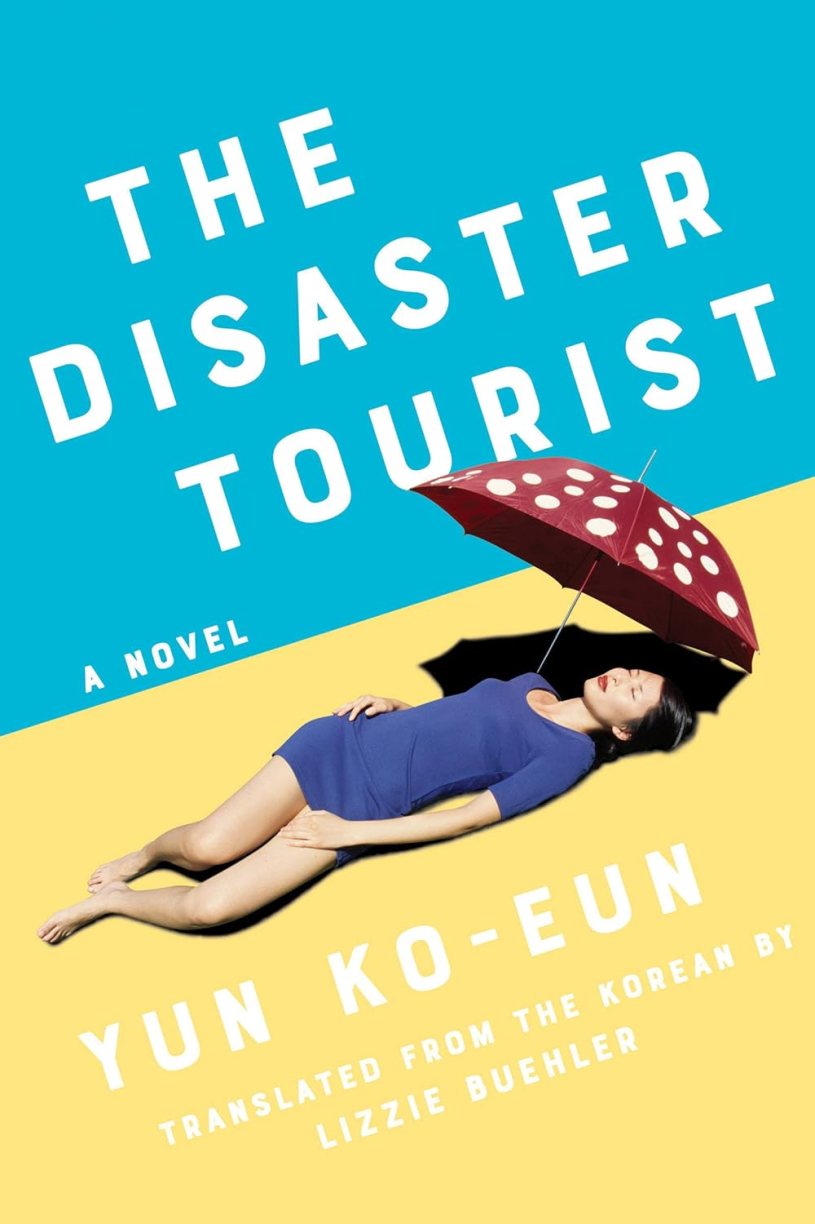
The Disaster Tourist
By Yun Ko-eun
Translated by Lizzie Buehler
(2020, Translated 2023)
Counterpoint
The Disaster Tourist has been on my TBR list for several years, though reviews have been mixed. Perhaps my wait has been rewarded. The version I read, translated by Lizzie Butler is new, and I found I could not put the book down! Amazon is promoting it as an “eco-thriller” that sends a shout-out to the #MeToo movement. In a not-too-distant future in Seoul where employees are– impossibly– even more overworked, cubicle-bound Yona finds herself in her mid-30s still employed by Jungle, a travel company that fills the needs of “disaster tourists.” These are wealthy patrons who wish to be transported to the heart of the latest natural disaster. They want to witness the terror of death from a relatively safe distance, engage briefly and politely with a community of survivors, perform an afternoon or two of good works, and depart. Yona designs these package tours, and if approved, Jungle invests in the hotels, restaurants, and other infrastructure to provide the tour-goers with a high level of security, luxury, and ease. When her boss’s unwanted attention erupts into a sexual assault, he tries to make peace with his employee by sending her on one of the company’s packaged tours: a trip to the island of Mui off the coast of Vietnam. Yuna is too smart not to recognize that she is already on thin ice at the company and that her supervisor may use her absence to stir up trouble for her in the office, but she accepts. Once on Mui, she becomes a careful observer of the tourists, the local community, the “story” the Jungle has created to make the Mui visit desirable, and the disaster sites. She has a keen eye, and it is not long before she realizes that most of what she sees from the tourist busses is theater. She also discovers that one of the tourists, a writer, has been hired by the jungle to bring new life into the Mui tour by staging a second wave of “natural disasters” that may or may not result in significant or perhaps massive civilian casualties. Yona begins as a sophisticated and harsh critic of Jungle’s colonial view of the different communities on Mui, but in time, she realizes that even the indigenous people see value in being used and embroidering their dying traditions to make an extra buck. Perhaps to keep her job, perhaps to make a big kill and get far away from Jungle, will she decide to embrace the inevitable and join in constructing the elaborate charade?
 East Asian Literature in Translation