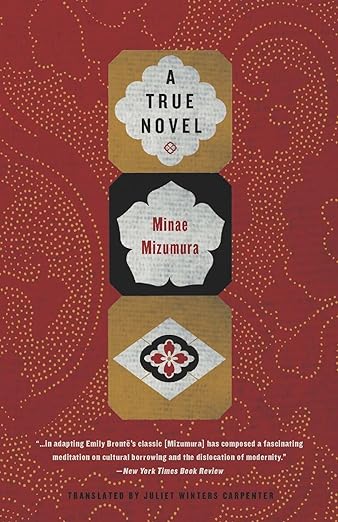
A True Novel
By Minae Mizumura
Translated by Juliet Winters Carpenter
(2002, translated 2013)
Other Press
Minae Mizumura was born in Japan in 1951. At the age of twelve, her family moved to Long Island. She studied studio art at the Museum of Fine Arts in Boston, and French at The Sorbonne, later earning a degree in French from Yale University. She has taught at Princeton, Stanford, and the University of Michigan. In order to understand the complexity of Minae’s project in the provocatively titled A True Novel, it is essential to comprehend the deep, deep study of literature and language she is engaged in, as well as her experience of moving to the United States and her life in France. She grew up studying classic American and European literature, yet she writes in Japanese and published this particular novel serially in a Japanese literary monthly. A True Novel is a work of ideas. Minae seems to be pushing at the boundaries of what writing can do while also provoking the reader–whether in jest or not remains to be seen. The title itself is self-referential, as is the marketing of the novel: on Amazon, the book is introduced as “A True Novel: A Remaking of Charlotte Brontë’s Wuthering Heights.” In her introduction, she tells us that while living in Long Island, her father hired a young driver, a penniless man named Taro Azuma. After telling us that she is a professor of literature in New York City, she explains she is reviewing what she knows of Azuma because she has received a visitor, Yusuke Kato, who met Taro Azuma and found the story he told fascinating. Kato claims that Azuma mentioned Minae by name and hopes that she can corroborate and add further detail to what Azuma told him. As it happens, Minae has been working on an “I-Novel,” which is a uniquely Japanese genre that is written in the first person, confessional in tone, and features elements from the author’s own history. She explains that after her meeting with Kato, she is inspired to write “A True Novel,” which she explains is a work of complete fiction. Minae’s story begins with Kato’s recollection of how, while he was visiting a friend in a rural area, he got lost in the dark and damaged his bike colliding with a fence. The owner of the house is a morose, middle-aged Azuma who tells a compelling tale to the young man. The next morning, Azuma is incommunicado, but his maid, the delightful Fumiko, like Brontë’s Nelly Dean, volunteers to tell Kato more about her gloomy master. Fumiko explains how, after the Greater East-Asia War her father found her a position in Tokyo working as a nanny and maid for a family of wealthy merchants, the Saegusas. She serves Saesuga Natsue and her two daughters, Yuko and Yoko. Another family servant, the aging Roku, is able to find work for his nephew in the growing household. The nephew brings his family, which includes young Taro. Fumiko is shocked to discover that the family physically abuses the boy and learns that his origins are complex and unknown even to him. Fumiko takes it upon herself to act as the boy’s champion, and over time young Yoko and Taro become the best of friends–our Catherine and Heathcliff. Minae’s tale is more complex than Wuthering Heights, in large part because she is also telling the story of post-war Japan through the experiences of those broken by the war, the merchants and the wealthy Japanese who came to the US in the 1960s to sell products and expand their businesses, and even members of the royal family who lost their fortunes, influence, and protection. The furiously over-the-top love affair between Taro and Yoko rages and dies in endless self-destructive cycles. Nevertheless, the standout of Minae’s text is the wonderful Fumiko, whose secret-keeping, eavesdropping, and well-meaning scheming always finds a way to do Brontë’s Nelly Dean one better.
“…I was staying in Palo Alto in northern California, writing my third novel or, more precisely, trying to write it. I lacked confidence and was making slow progress. Then, out of the blue, I was made a gift: a true story, just like a novel. What’s more, I was the gift’s sole recipient. The story was about a man I knew, or rather my family knew, in New York at one time. He was no ordinary man. Leaving Japan with nothing, he arrived in the U.S. and made a fortune there, literally realizing the American dream. His prosperity had become a legend among the old Japanese communities in New York—yet no one knew that he’d had another life, marked in the beginning by the poverty-stricken period that followed the war in Japan. The tale would almost certainly have disappeared, lost in the stream of time, if one young man who happened to hear it in Japan hadn’t tucked it away inside him, crossed the Pacific, and delivered it to me in Palo Alto.
 East Asian Literature in Translation