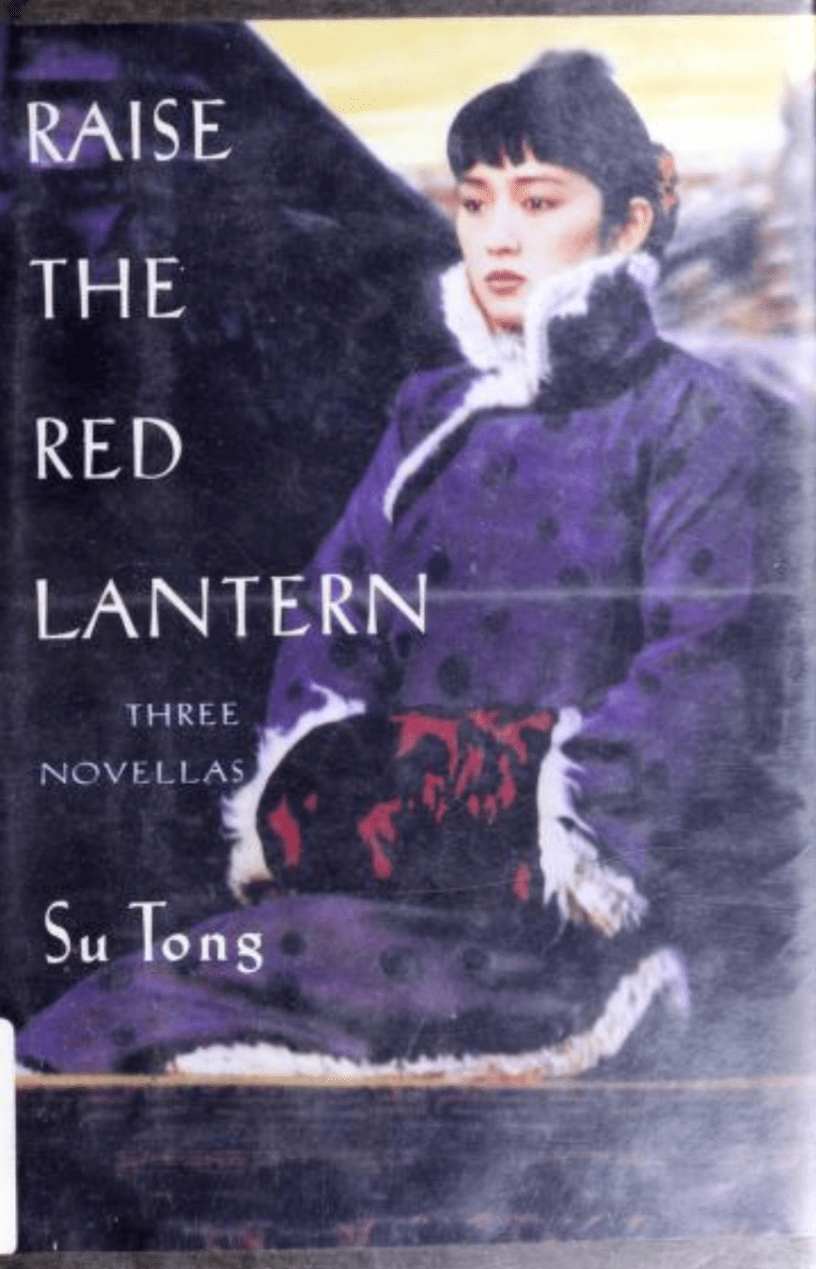
Raise the Red Lantern: Three Novellas
By Su Tong
Translated by Michael Duke
(1990, translated 1993, first Perennial Edition 2004)
Perrenial
(Novellas)
The three novellas in this collection are Raise the Red Lantern, Nineteen Thirty-Four Escapes, and Opium Family. Su Tong sets the stories in the 1930s. There has been a worldwide depression, and the Republic of China is in a perilous position. Chiang Kai-shek’s Guomindang finds itself taking out massive loans to pay debts and maintain some semblance of economic stability. Meanwhile, more and more families in economic crisis are failing and looking for relief from other political parties. Su Tong’s characters are all victims of economic collapse. In Raise the Red Lantern, the heroine, Lotus, comes from a well-to-do and progressive family. Her father, a tea merchant, sent her off to college. But at the beginning of her sophomore year, her father’s business failed, he committed suicide, and her family sold her into service as the fourth concubine of fifty-year-old Chen Zuoqian. As the youngest and last of the concubines, she is mocked and degraded by the other women in the household. They control what she eats, what labors she must perform, and when her master has access to her. It is also a place of great danger: she is warned that concubines who are unfaithful to Old Master will be killed. A beauty, it is not surprising that she has admirers. More spectacularly, though, especially for the time period, she possesses both agency and desire, so much so that she is able to use the old man to raise her status within the household. Unfortunately, she lives in a prison run by women and there will be no escaping her destiny. Nineteen Thirty-Four Escapes takes us to Maple Village in 1934 and the family of Chen Baonian and his wife Grandma Jiang. This is a town where love and Confucianism is dead. Though he owns a good furniture business, Chen Baonian, sells his sister into concubinage so that he can buy a few acres of land. Then an epidemic of typhoid sweeps through the village, killing five of Grandma Jiang’s children. Before they are even cold in the ground, her husband takes up with another woman. How can Grandma Jiang endure her cruel fate and her husband’s boundless greed?
In the last novella, “Opium Family,” Su Tong relates a sad tale of a family that entered into the opium trade and became one of its victims. A caveat: Be advised that Su Tong is one of the first writers after the Cultural Revolution to address the topic of homosexuality. That in itself is significant. However, be aware that modern critics find Su Tong’s portrayal of male homosexual love as evidence of a failure of one of the men’s inability to act on his heterosexual desire.
“The first time Chen Zuoqian went to call on her, Lotus barred the door and refused to see him; ‘Meet me at the Restaurant Occidental,’ she said from inside the door. Chen Zuoqian thought to himself that since she was a college student she would naturally be different from most vulgar young women. He reserved a table for two at the Restaurant Occidental and waited for Lotus to show up. It was raining that day and as Chen Zuoqian waited and looked through the window at the street made misty by the rain, his emotions were unusually warm and sweet; feelings he had never experienced before in his first three marriages. Lotus came walking slowly along, carrying a delicate little flower-patterned silk umbrella. Chen Zuoqian smiled happily. Lotus was just as pure and pretty as he had imagined, and just as young. Chen Zuoqian remembered that Lotus sat down opposite him and pulled a big handful of little candles out of her purse. She whispered to Chen Zuoqian, ‘Order me a cake, all right?’”
 East Asian Literature in Translation