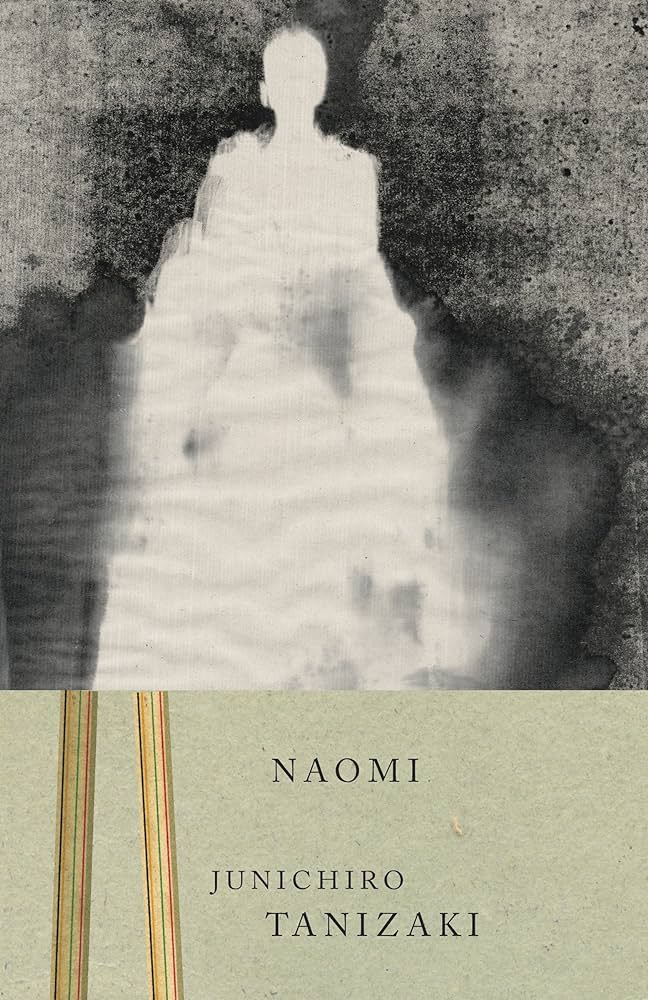
Naomi
By Junichiro Tanizaki
Translated by Anthony H. Chambers
(1924, translated 1985)
Vintage International
(Novel)
This novel is about an obsessive sexual relationship between Joji, a college-educated salaryman, and Naomi, the daughter of a brothel owner. Tanizaki titled his novel Chijin no Ai, A Fool’s Love, which suggests that his primary focus is on the disturbing nature of Joji’s desire to possess a virgin, raise and worship her as a chaste beauty, and marry her. The relationship begins when the economically successful but socially isolated Joji discovers a shy and withdrawn serving girl at a brothel. Although he does not speak to her, Joji makes a bid to purchase her, promising that he will feed, house, and clothe her until she is of marriageable age. At the time, Joji is twenty-eight years old and Naomi is fifteen. The English translation favors Naomi, which focuses attention on the object of Joji’s obsession, the child Naomi. Joji is not unlike Humbert Humbert of Lolita, except that he does not have to go to excessive lengths to possess the object of his desire. Tanizaki’s lovers are sensualists in the extreme. Joji begins his relationship with his child bride as a father figure, but it is not long before Naomi turns the tables on him, slowly exhausting Joji’s nest egg with her desire for more fashionable clothing than she can compare, take out from Western restaurants, and endless nights of European-style dancing. Tanizaki satirizes Taisho period Japan’s fetishization of all things European. Naomi’s European-sounding name, strikingly Eurasian features, and white skin draw Joji’s lust like a magnet. He reads English, but he has such a strong accent that he struggles with speaking English in social situations. He also prefers to dress Naomi in Western styles; the two comb fashion magazines together, shop for fabric, and have dresses made for their whirligig of a social life. Tanizaki wrote the novel in serial form, publishing the early chapters in the Osaka Daily News before shifting to the magazine Female, where the story found its audience. After the cultural destruction of the Meiji Restoration, women’s roles shifted dramatically. More women left the countryside to pursue work in factories and as cashiers, waitresses, and shop assistants to staff the modern stores that were feeding Japan’s budding new consumer society. Young women were making money, living on their own, making their own decisions, and choosing men without the influence of their parents. Naomi is, to some extent, one of these modern girls, a Japanese “flapper.” Hapless Joji has created and nurtured his love, studied her every need, and shaped her as he desired her to be, but in the end, she rules over him like a master. She is something of a monster, but as it was Joji who made her so, it is only fitting that she triumphs over him and he smiles at his humiliation.
“Why I, a man of twenty-eight, had my eye on a child like that, I don’t understand, but at first I was probably attracted by her name. Everyone called her “Nao-chan.” When I asked about it one day, I learned that her real name was Naomi, written with three Chinese characters. The name excited my curiosity. A splendid name, I thought; written in Roman letters, it could be a Western name. I began to pay special attention to her. Strangely enough, once I knew that she had such a sophisticated name, she began to take on an intelligent, Western look. I started to think what a shame it would be to let her go on as a hostess in a place like that.
In fact, Naomi resembled the motion-picture actress Mary Pickford: there was definitely something Western about her appearance. This isn’t just my biased view; many others say so, even now that she’s my wife. It must be true. And it’s not only her face — even her body has a distinctly Western look when she’s naked. I didn’t learn this until later, of course. At the time, I could only imagine the beauty of her limbs from the stylish way she wore her kimono.”
 East Asian Literature in Translation