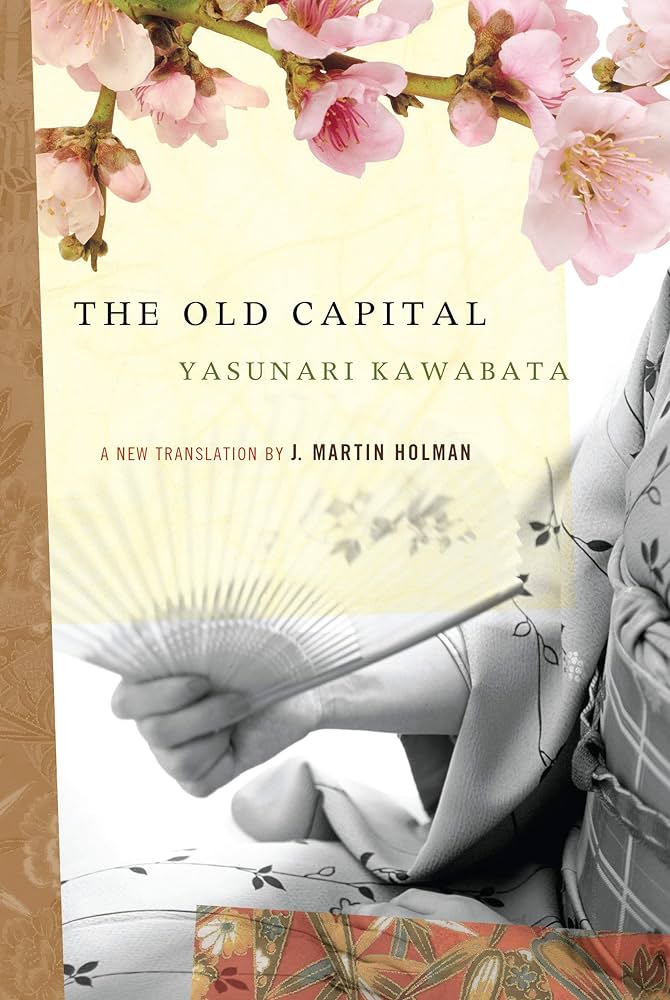
The Old Capital
By Kawabata Yasunari
Translated by J. Martin Holman
Kawabata’s The Old Capital, published in 1962, is exquisite in every way. We are in Kyoto, which, especially compared to modern Tokyo, was not so damaged by World War II that it lost its character or reputation as the cultural seat of the great Japanese traditions. Kawabata’s high regard for the old ways is center stage in this novel. Yet, as the novelist draws the reader’s attention to beauty, ritual, and practice, he is fully aware he and his characters are living through a time of cultural change. The embodiment of this crisis is our hero, a beautiful young woman who was raised since birth by loving, adoptive parents. Who is she? What is her lineage? And what will be her fate as she confronts her true identity and imagines who she will become while facing the offers of rival suitors? When she visits the village of her doppelganger, she is charmed by its natural beauty. Kawabata uses the close relationship between the villagers and the forest world they inhabit to advocate for a return to a less exploitative interaction between modern capitalism and nature while also noting that in even the oldest traditions, man is compelled to interfere with the natural order. Why is it that woodsmen can not be contented to let trees grow as they will and must instead crop, cull, twist, and almost torture nature in order to create a product that is both pleasing to the eye and “more efficient.” Kawabata also uses the villagers’ reshaping of their environment as a commentary on how the heroine is shaped by her adoptive parents who, as specialists in designing and constructing kimonos and obis, are also facing pressures to modernize. Consider this conversation this conversation between Chieko and her look-alike guide, Masako:
“It is nothing unusual for women to labor right alongside men. Farmers are like that, aren’t they? Greengrocers and fishmongers too,” Masako said casually. “A genteel girl like you would be impressed by such things.”
“I consider myself a laborer too. You must be talking about yourself.”
“That’s right. I don’t work,” Masako said frankly.
“It’s easy to talk about it, but I wanted to show you how these village women really work.” Chieko again looked up at the cedar mountains. “They’ve already started the branch cutting.”
“What do you mean, ‘branch cutting’?”
“They cut off unnecessary branches with a hatchet to produce good trees for logs. Sometimes they use ladders, but often they have to jump from the top of one tree to the next like monkeys.”
“How dangerous!”
“I hear some men climb up in the morning and don’t come down until lunchtime.”
Masako too looked up at the cedar mountains. The straight, orderly trunks were beautiful. The clusters of leaves left on the branch tips resembled a fine-crafted work.
The mountains were neither high nor deep, so the trunk of each individual tree was visible even on the tops of the mountains. The cedars were used in the construction of tearooms, so the groves themselves had the elegant air of the tea ceremony.
 East Asian Literature in Translation