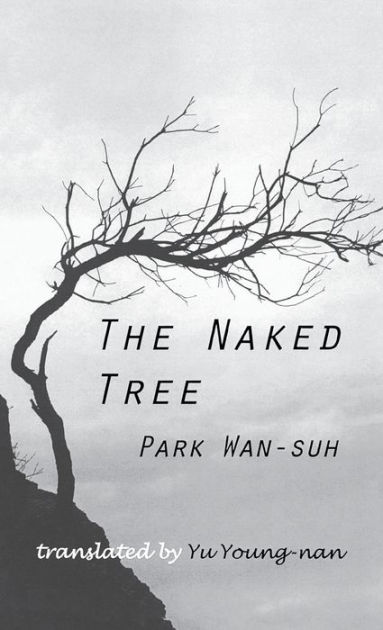
The Naked Tree
By Park Wan-suh
Translated by Yu Youngnan
(1970, translated 2011)
Cornell East Asia
The Naked Tree was Park Wan-suh’s first novel, published in 1970. The story is set in Seoul in 1951. Lee Kyong is twenty, going on twenty-one. She lives alone with her mother in a once beautiful traditional Korean home. She works in a small stall in the American PX, where she acts as a salesperson tasked with persuading G.I.s to have photographs of their wives or girlfriends painted onto silk scarves. She manages the four painters who work in the back room. Mis. Lee, or Kyong-a, spends her days trying to hustle up business, and keep peace among the painters while fantasizing about the glamorous young Korean salesladies who hawk American-made goods in the PX, the female cleaning staff and their smuggling operations, and the unwanted attentions of Korean and American men. She saves whatever earnings she can and returns each night to a mother who has lost the will to live and is unable to nurture her love-starved daughter. Young Miss Lee’s resentment toward her mother is heartbreaking, especially as her mother is clearly broken by her husband’s early death and her experience of the Communist attack on Seoul, their temporary, and their subsequent retreat. Even now, Kyong-a can hear the sounds of heavy artillery and longs to be anywhere other than Seoul. Park’s heroine is desperately lonely and yearns for love. She falls hard for Ock Hui-do, an older man who comes to join the cast of cranky and bitter scarf painters. At the same time, young Hwang Tae-su, a wounded veteran training as an electrician, begins pursuing Kyong-a. Miss Lee finds her Tae-su attractive enough, earnest, and reliable, but she is trapped in her doomed relationship with Ock Hui-do, who is married to a beautiful woman and the father of five children. Given her situation at the beginning of the novel, it is easy to feel sympathy for her plight, but as her loathing for her mother intensifies and her manipulation of family members and the two men she is involved with becomes more outrageous, her behavior becomes more and more difficult to comprehend. Thankfully, before this fascinating character further wounds herself and the people around her, Park reveals the cause of her and her mother’s despair and the conflict that rages between them. The Naked Tree is essential reading for anyone interested in the lives of civilians and soldiers in Seoul in 1950 and 1951.
Readers should be aware that characters in the novel use the word “mongrel” to describe white American service members and the N-word to describe Black Americans.
“Chungmu-ro, the busiest street in Seoul, was nothing more than a collection of unlit buildings and dark corners at this point in the war. Most of the monstrous buildings were unoccupied and some, like the Central Post Office building, stood with only their facades intact, the tops blown off by bombs and artillery. Fright swept over me at every dark corner, and the darkness brought home the reality that we were still in the middle of a war.”
 East Asian Literature in Translation